To My Readers


If this is the first time you're visiting my blog, thank you. Whether you're interested or just curious to find out about PCB reverse engineering (PCB-RE), I hope you'll find something useful here.

This blog contains many snippets of the content in my books to provide a more detailed overall sampling for my would-be readers to be better informed before making the purchase. Of course, the book contains more photos and nice illustrations, as evidence from its cover page. Hopefully, this online trailer version will whet your appetite enough to want to get a copy for yourself.

Top Review

I started doing component level repair of electronics with (and without) schematics more than 40 years ago, which activity often involves reverse-engineering of printed circuit boards. Although over the years my technical interests have shifted into particle beam instrumentation, electron microscopy, and focused ion beam technology fields, till this day——and more often than not——PCB repairs have returned multiple multi-million-dollar accelerators, FIB, and SEM instruments back to operation, delivering great satisfaction and some profit.

Many of the methods described by Keng Tiong in great details are similar to the approaches I've developed, but some of the techniques are different, and as effective and useful as efficient and practical. Systematic approach and collection of useful information presented in his books are not only invaluable for a novice approaching PCB-level reverse engineering, but also very interesting reading and hands-on reference for professionals.

Focus on reverse engineering instead of original design provides unique perspective into workings of electronics, and in my opinion books by Keng Tiong (I've got all three of them) are must-read for anybody trying to develop good understanding of electronics——together with writings by Paul Horowitz and Winfield Hill, Phil Hobbs, Jim Williams, Bob Pease, Howard Johnson and Martin Graham, Sam Goldwasser, and other world's top electronics experts.

Valery Ray
Particle Beam Systems Technologist

Saturday, July 30, 2022

Final Appeal for Reviews

I'm into the final lap of writing Deciphering Schematics. And I have intentionally reserved the chapter on Deciphering Analog Circuits for the last but best cut of the pie. Below is a two-page sample:

This is also my final appeal for reviews on my book Manual PCB-RE: The Essentials. If you have not yet submitted your review on Amazon, now is the time to do so. Once my new book is completed, I will decide which three best reviews will get a free copy of it. Of course, the top ten reviews will make it to the Manual PCB-RE book on its next release as well.

So don't delay or hesitate any longer. Time is ticking away...

Ps: For those who have submitted, please ensure your proper names are correct. If you don't wish to make known your organization or company, at least provide your city and country where you reside in. Thanks!

Wednesday, July 27, 2022

CoVid Disruptions

The past weeks have been pretty rough going. Since the government adopted the CoVid endemic policy on the premise that over 90% of Singapore's population has been vaccinated and reopened the borders, cases of infection have since skyrocketed.

First, my mum contracted the virus and worse, had outbreak of shingles. I brought her to see her regular doctor who prescribed medication for the latter. Thankfully, after a week and a half she recovered. Sadly, however, a close friend of mine recently succumbed to the virus after experiencing high fever for over a week. The first doctor gave him a week's MC and told him to self-isolate at home. After a week, he went to another doctor who told him it's normal and prescribed some medication for sore throat and cough. Bad diagnosis... barely three days later he collapsed at home and was sent to the A&E. But it proved too little too late.

He was only 54 when CoVid took him from his family. It affected me quite a fair bit, though I'm sure his bereaved family will be most grieved by the lost of a father and husband.

I'm into the last mile of Deciphering Schematics, but writing proves difficult during this period with messages coming and going from friends and this family whom I've come to know personally. I just need to take a breather and regather my thoughts so that I don't write nonsense that will break the trust of my readers.

Life is just so frail and unpredictable. CoVid only makes it more apparent, I suppose. Rest in peace, my dear friend...

Saturday, July 9, 2022

It's All About Connections

When it comes to writing an engineering book, some authors may not follow the order in which he or she planned or laid down the contents. I happened to belong to this group. Inspiration is a funny thing and can be disruptive at times. For example, when I started out writing on the Philips AZ102 Sound Master part, I placed it in the Analog section of the book. Half way through, it dawn on me that this illustration fits better in the Hybrid section, so I moved it over there and continue writing.

Here's a two-page sample:

I hope to complete this deciphering example by mid next week, then go back to the Analog section to finish up the remaining portion. That should cover about 95% of the book. It will take another 1 week for me to proofread and brush up the whole book. I'm still thinking who I should approach to write the Foreword, or is it necessary? Any suggestion from my readers?

And oh by the way, if you have not leave your review for Manual PCB-RE yet, now is the time to do so. Don't wait till the last minute because you may forget and forgo the chance of having your name included in the next release of that book, and lose the opportunity to get a free copy of this book (Deciphering Schematics) if you make it to the top three.

Monday, June 27, 2022

Analog Sentimentality

Writing an engineering book is not all about technicality on the subject matter. Sometimes, a little sentiment can come in handy to give an otherwise intellectually stimulating topic an emotional dimension. Readers may not know it yet, but I think it's about time I reveal the person I'm dedicating Deciphering Schematics to——my mother.

Neighbors knew her as a dedicated homemaker, but she is more than that (at least to me). All her life (she's nearly 80) she abides by the principle of integrity, despite a hard life in her early to middle years. In fact, some relatives took advantage of this and swindled all her limited dowry, leaving only a pair of bangles which she passed to my wife on our wedding. But instead of being bitter, she became stronger in her character and conviction. And I'm proud to say that she has taught me well by her own example.

So here it is:

To my mother——a woman who, despite her lowly education, taught me the value of integrity that shaped my character and attitude. This book is dedicated to her for showing me how to decipher the myriad of choices in life and to discover my true passion in the world of electronics.

Sometime back, the Philips CD Sound Machine I bought her stopped working. I took it back to see if it could be fixed, then realized that some electronic parts have died. But I did not throw it away and get her a new one because it has sentimental values. After some thought, I decided it would be a good idea to immortalize this sentimentality by including it as an extra teaching material in my book.

Here is a two-page sample:

Things don't last forever, but memories do, at least for a lifetime.


Thursday, June 23, 2022

2nd Appeal for Reviews

Since putting up the appeal for reviews for Manual PCB-RE: The Essentials, there were several submissions posted on Amazon:

This is a good sign. But it still falls short of the number I hope to achieve in order to include into my next release of the book. So I'm making the appeal again to readers who have bought the book to post their reviews. The top ten will have their names and company (if they're comfortable) mentioned on the front inner pages where the reviews will be listed. And the top three entries will receive a FREE copy of my upcoming book Deciphering Schematics.

Don't wait till the last minute. Opportunity never knocks twice!

Friday, June 10, 2022

hardwear.io USA 2022

It's an exciting time at the Delta Hotels in Santa Clara as the much awaited hardwear.io USA 2022 event kick-started. Below is the schedule of the two-day programmes:

Many experts from various fields of hardware hacking will be giving their talks, demonstrating their tools and techniques, and answering questions from participants. Among them are keynote speakers Joe Grand and Window Snyder, and invited speakers Andy Nguyen, Cristofaro Mune, Damien Marion, Duy-Phuc Pham & Annelie Heuser, Daniel Genkin & Roei Schuster, David Kaplan, Derek & Ryan Chow, Francesco Restuccia, Karim Abdellatif, Laura Abbott, Sick Codes, Steffen Robertz, Steve Povolny & Sam Quinn, Jay Cox & Nic Watson, John McMaster, and Marcus Richerson.

A day or two before the event, speakers and hardwear.io staff could be seen setting up their wares and equipment to impress the participants:

Of course, such a large-scale event could not have happen without strong support from sponsors like Google, Leviathan Security Group, Quarkslab:

I'm certain those who made it to this event will have a smashing time learning new skills and winning some prizes, not to mention meeting these hardware legends in person.


Wednesday, June 1, 2022

Appeal for Reviews

Since it's release about a year ago, Manual PCB-RE - The Essentials has sold quite a few copies despite little publicity and no advertising. Unlike the first three books, the only thing lacking is reviews from readers. Would love to hear from my readers what they think about the content of this book, whether it has helped them learn or pick up essentials in this niche skillset and enable them to be more proficient in their PCB-RE work.

To encourage readers to publish their reviews on Amazon, here's the deal:

1. The ten best reviews will be included in the next print release of the book. This will give reviewers good exposure and publicity so please include your name and job title if you are employed, or company name if you own a business.

2. The top three reviews will get a free copy of my upcoming book, Deciphering Schematics, which will be released sometime in the third quarter of this year.


The deadline for acceptance of reviews will be the date of release of my upcoming book. If you have not gotten a copy of Manual PCB-RE, now is the time to place your order and put in your review. This offer is also extended to those who already own a copy so delay no more and submit your reviews today!

Your positive feedback is my motivation to write.

Tuesday, May 31, 2022

hardware.io PCB-RE Book Giveaways

I seldom receive more than three notifications on my Twitter account, simply because I'm quite careful who I follow to prevent being overwhelmed with indiscreet posts. However, today I received 20 post notification from a single thread started by hardwear.io featuring Joe Grand aka 'Kingpin':

Was wondering what's causing the buzz and realized there was a book giveaway promotion featuring my latest work, Manual PCB-RE - The Essentials:

This is certainly one effective way to create interest and draw a following to an event, much like ScanCAD who give out two of my books at their exhibition booth in-country and across Europe, with much fanfare and success in attracting potential customers to link up with their businesses. Another company that give away my books is Teel Technologies which specializes in providing training workshops on Mobile Forensics.

If you're running a seminar, workshop or exhibiting your business at a trade fair, maybe you want to consider this idea as well. Take it from the pros and see your sales improve!

Tuesday, May 24, 2022

Simply Sensational...!

Well, sort of, considering that many of today's home appliances and electronic gadgets contain a variety of sensors and transducers to make our lives convenient and comfortable. Some people though, tend to get confused over the two, thinking they are the same when there is a difference:

If ever Tony Stark's Iron Man suit get to materialize in real life, you can bet that it will contain all sorts of sensors interfaced to the central processing AI brain called JARVIS.


So we see that sensors and transducers are indispensable, not only in our mundane daily routines but also in the Marvel Comic Universe and possibly the Metaverse in the not too distant future...

Saturday, May 21, 2022

Active Discrete - Transistors

If two is company, then three is a crowd——unless it happens to be a transistor. In the early days, this term is almost always associated with the germanium or silicon based maverick that has permeated into every electronic devices since its inception. Today, it's a different story altogether.

The transistor story, however, can be traced as far back to the era of the thermionic valves. I remember well the first lesson I had in my secondary school days was the theory and operation of the venerable triode. Talk about big brother!

Walter Brattain, John Bardeen and William Shockley of the Bell Telephone Laboratories might have been proud of their breakthrough when they came up with the first transistor prototype, but I believe Sir John Ambrose Fleming should be credited with the invention of the thermionic valve which ultimately led to the birth of the transistor four decades later.

Today's engineers certainly walk on the shoulders of these giants of bygone years.

Monday, May 16, 2022

Active Discrete - Diodes

I suppose the most common active discrete components that electronic engineers are familiar with should be the versatile diode:

For a simple two-terminal dual junction semiconductor device with non-linear electrical properties, it may come as a surprise that there are literally a bunch of variants exhibiting different characteristics and used in varied applications.

Considering the fact that the diode had existed since the cold war era as a vacuum tube entity, imagine the progress it has made to arrive at the forms that it is today:

What will the future hold for semiconductor electronics as wafer technology and manufacturing reaches its physical limits? Nobody knows. One thing is for sure——diodes are here to stay for quite a while. As they said, "You've come a long way, baby!"


Friday, May 6, 2022

Nostalgic Fontasy

When I wrote my first engineering book on the PCB-RE subject, I was more focused on the content than the presentation, and took little notice of the font type and style. As a result, some would-be buyers were turned away by the 10-point Calibri typeface which, though not a bad font, is rather uncomfortable to read for those with myopia issue. (To be honest, this fact had been bugging me for quite a while but I just did not have the time to address it and put it to rest.)

Subsequently, when I wrote the sequel and trilogy, I changed the font to a 12-point Franklin Gothic Book typeface which is easier on the eyes for those preferring printed copies. But I still retain the old format for 'The Art' book out of nostalgic sentiments. After all, it is my very first piece of work. Seven years down the road, I decided that a facelift is due so without much fanfare, I did a revamp and changed the font type to Franklin Gothic Book as well. This will ensure consistency for all my PCB-RE series. Here is a side-by-side comparison sample page:

I have also re-done the book cover (front and back):

Those who bought my original edition can take comfort in knowing they now own a 'limited edition' that is no longer in circulation. (Heck, it might become a collector's item in a few years time, who knows?) For those who have yet to get a copy of 'The Art' book, this change might just be the nudge you need.

Now I can finally put this behind me and get back to writing my next engineering book...

Saturday, April 30, 2022

Passive Discrete - Inductors

Back to basics (covered in Deciphering Schematics):

Resistors, capacitors, and inductors are primary types of passive discrete components. In their most basic form, they come with two-terminals, through-hole or SMD. The chart below shows the types of inductors:

Inductors are coils with one or more windings of conductive wire wrapped over a medium (air, ferrite, etc.). Current flowing through an inductor induces a magnetic field that serves as a storage of energy (i.e., Eb = -L[ΔI/Δt]). It also generates a counter electromotive force (plus induced current) that restricts the flow of alternating current while allowing direct current to pass through. 


Thursday, April 28, 2022

Passive Discrete - Capacitors

Back to basics (covered in Deciphering Schematics):

Resistors, capacitors, and inductors are primary types of passive discrete components. In their most basic form, they come with two-terminals, through-hole or SMD. The chart below shows the types of resistors:

Capacitors has the ability to store electrical charge exponentially, the amount of charge being determined by the capacitance value and the voltage applied across the device (i.e., Q = CV). One important use of capacitors is passing alternating current while blocking direct current, also known as ‘AC coupling’.


Wednesday, April 27, 2022

Passive Discrete - Resistors

Back to basics (covered in Deciphering Schematics):

Resistors, capacitors, and inductors are primary types of passive discrete components. In their most basic form, they come with two-terminals, through-hole or SMD. The chart below shows the types of resistors:

Resistors oppose (restrict, limit) the flow of current and are employed to control current and manage voltage levels in a circuit. The relationships between resistance, voltage and current conform to Ohm’s Law such that current is proportional to the applied voltage and inversely proportional to the resistance (i.e., V = IR).


Saturday, April 16, 2022

A Special Birthday Request

Two days ago, I celebrated my wife's birthday. She did not ask for anything fanciful or expensive, just something simple: kite flying. So I bought her a beautiful butterfly kite that could be easily self-assembled and we went to a nearby coastal park after breakfast to fly it. Thankfully the weather was sunny with a cool breeze, which made kite flying a breeze (pun intended).

See how happy and delighted she was? That's the simple pleasure of life!

As it was a weekday, there were not many people around so we literally had the whole field to ourselves, which was kinda nice. Since the kite was on 'auto-pilot' we decided to sit near the shoreline and listen to the waves splashing while enjoying some quiet moments together. A few passers-by seemed absorbed with the quiet fun we're having, and one even requested to take a snapshot for us. For lunch, I treated her to a vegan Thunder Tea rice.

It's my way of showing appreciation and saying thanks to her for being supportive of my writing journey the past six years, this year being the seventh and probably the last. Thanks, my love, for being there and encouraging me to fulfil my dream and passion as an author!

Tuesday, April 12, 2022

A Worthy Mention

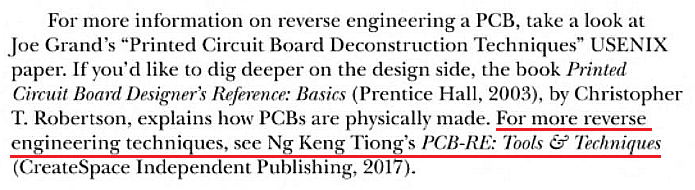
Books on hardware hacking are on the popular rise and there are a few notable titles that aspiring hackers can learn from. One book, in particular, is The Hardware Hacker's Handbook by Jasper van Woudenberg, which is really about overcoming embedded security.

I'm not giving a review here, in case you're wondering; rather, I was surprised and delighted that the author of this best seller mentioned my sequel, PCB-RE: Tools & Techniques in Chapter 3 (page 106) of his book, which I have produced and highlighted below:

It's always a nice feeling when your work is noticed by another author, a practice I engaged in my own writings to point interested readers to useful sources who want to learn more about a particular related topic. As always, the first and sequel PCB-RE books seem to be a natural choice for those starting out in their PCB-RE journey.

Writing engineering books is hard work that doesn't guarantee success unless there are good reviews and wide publicity from readers and supporters. So I'm counting on you, my friends, to spread the word and help recommend my books. Thanks in advance!

Monday, April 11, 2022

Spoiler Alert!

If there's anything to indicate what you'd be getting from Deciphering Schematics, besides nicely drawn (and well-proportioned) schematic diagrams, there will also be beautiful illustrations such as that found in the following two-page sample from Chapter 5:

Sure, it's going to cost me time and effort to come up with all these vector-based drawings. As an author who writes engineering books that bear my name, I'm not about to let poor reading experience leave a black mark on my hard work. I want readers who buy my books to be assured of the best quality, knowing they are worth every cent of it. And I certainly hope readers will give me the assurance in kind through honest purchases too.

But I can only leave it to personal integrity and just do my part well. In the end, as they say, everything will even out. Meanwhile, stay safe and well, my friends.

Thursday, April 7, 2022

Update on Chapter 5

Been working relentlessly on this chapter for the past couple of weeks and nearing completion. By far, this is the most interesting chapter to write. I've covered quite a bit on the elements of analog circuits, from the issues of discrete versus integrated, passive versus active, and mechanical versus solid-state, on to circuit topologies involving transistors, MOSFETs and operational amplifiers.


Trying to cover every aspect of analog circuits is near impossible, so I choose to highlight the essentials and what topologies best represent the elements discussed. Hopefully readers will catch on and expand on what they have learned to further enrich their understanding in deciphering schematics. Of course, I will follow on with a chapter that showcase a full-blown analog circuit and how to go about making sense of its functionalities and design. After all, what is theory if there is no practice, right?

As to why I decided to write this book before PCB Diagnostics (which I started out after completing the PCB-RE series) is because I realize that understanding circuit diagrams is an important key to repairing circuit boards. For readers who have no foundation in electronics, this book will give a good overview of what constitute digital, analog and hybrid circuit designs, with an added bonus on power supply circuits.

It should be a book worth waiting for, though it's by no means easy on my part to write it, coming from the perspective of someone wishing there is a better way to be given a broad overview of electronics  (interesting and informative enough without all the nitty-gritty details) and the know-how in decoding the blueprint that made up these circuits.

Friday, March 18, 2022

Analog Circuits

Now that I've completed the section on deciphering digital circuits, it's time to move on to something more interesting and different——analog circuits. As you would probably know by now, my style of writing is geared towards engaging the readers so I tend to use metaphors here and there to bring out certain concepts for better clarification or understanding. Here's the introduction to the next section of my book:

If you'd notice, even the choice of fonts is intentional to intrigue my readers. After all, it's about deciphering, get it? I'm a perfectionist and I'll spare no effort in making sure that each book I write bears the mark of my craftsmanship, which is why I'd painstakingly draw (and redraw) my illustrations in Visio for the best picture quality possible.

For the amount of time and effort put in, it should be worth every cent readers paid for my books. All I ask is for those who believe in rewarding hard work to support authors like me with honest purchase——not shortchange or steal my months of sweat and toil. Someone once said:

If it costs you peace of mind and your conscience, the price is too high.

So do yourself a favor by doing what is right. 


Tuesday, March 15, 2022

Update on Chapter 4

I've completed Chapter 4 of the book Deciphering Schematics. Besides going through a 3-page MCU-based schematic diagram, I've added a bonus section that showcase a CPLD circuit:

Now, I need to make it clear that I'm teaching readers how to decipher a circuit. It is beyond the scope of this book to teach CPLD programming, so don't expect any lesson on hardware description language or how to program FPGAs. There are plenty of resources available online that readers can easily find and learn from, whether in written form or video tutorial.

Nonetheless, I do make recommendations every now and then on useful resources that are related to the topics I'm illustrating or discussing. Hopefully, that will supplement what this book does not cover and allow interested readers to pursue further on the subjects at hand.

That's all for this short update.

Friday, March 11, 2022

Out of the Woods, Finally...

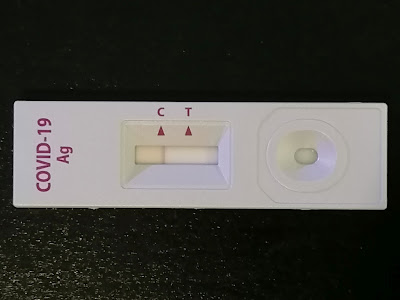
Since contracted the Omicron variant two weeks ago, we were basically out of action for one week due to symptoms of fever, cough, and muscle aches for myself. One week into recovery, we did another ART as instructed in the protocol. My wife came up negative but I was still positive, albeit the T line was much fainter:

Today, after 14 days and feeling much better without any more symptom, I did an ART after breakfast. This time I am finally cleared and good to go:

While the Omicron symptoms are considered 'mild' compared to the Delta variant, it still feels terrible once you are down with it. Having to struggle with body fatigue while working on my book is certainly no small feat. The physical discomfort does affect the mental capacity.

Thankfully with this episode behind me, I hope to catch up on lost time.

Sunday, February 27, 2022

Covid-19 Positive!

Ever since Singapore announced an endemic (living with Covid-19) policy with relaxed measures and opening up of borders through VTLs, the onset of Omicron has seen a marked increased in the daily cases of infection, though mostly with mild symptoms. Our health minister even preempted that it's only a matter of time before any of us will get it.

Last Friday, I woke up with body aches and a slight feverish feeling, so decided to do an Antigen Rapid Test (ART). It turned out positive. My wife did hers and the results confirmed that both of us are down with Covid-19.

According to the latest health protocol, it has to be 72 hours before we do another ART to assess if we are OK or need to serve a longer home recovery program.

Hopefully, at least one of us will be negative so we do not need to trouble our friends to help us get the groceries and meals. The so-called mild symptoms are not in anyway trivial as we experience coughs, vacillating fevers and muscle aches. I could only manage to do a bit of writing but most of the time I'm down and out due to fatigue from fighting the virus, despite having been vaccinated.

That's all for the update. Mind's a bit foggy right now...

Thursday, February 24, 2022

Deciphering Digital Circuits

Starting a new chapter on this topic. I intended to illustrate using two real-world examples: a MCU-based mixed design and a CPLD experimental board. Here's the introduction page:

It's not easy to cover every aspect of digital circuits. My focus is more on understanding and making sense of a schematic diagram, rather than how to be a hardware or firmware designer, which itself is a subject that can fill a volume or more. So it's important to manage your expectations.

Chapter 3 will also contain quite a lot of information on various digital circuit design aspects, which you might already have some idea based on my previous posts. Hopefully, these should cover enough ground on the digital aspect of schematic diagrams.

Thursday, February 17, 2022

Progress Update

The start of a new year has always been busy with tight schedules, more so with the constant changes in government policies over the evolving pandemic situation. Thankfully, after a hectic Lunar New Year saga, I am able to sit down once again and resume writing.

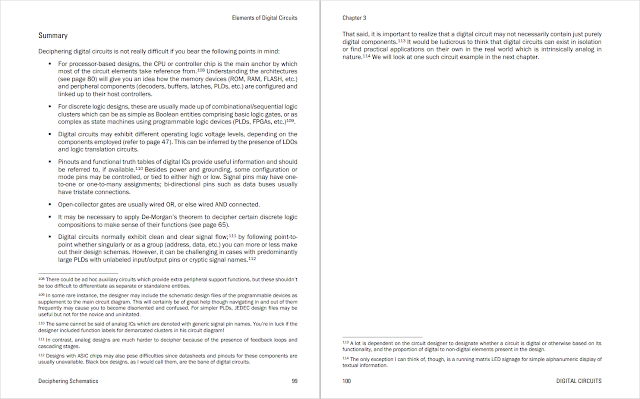
Finally, completed Chapter 3: Elements of Digital Circuits for my book, Deciphering Schematics. Here is the Summary page at the chapter's end:

I've outlined nine chapters plus several appendices for this book, so at 100 pages currently, I foresee it will probably run up to 250 pages or more when it's completed. I still have the other book, PCB Diagnostics, at the back of my mind but somehow I don't seem to have the motivation to work on it, yet.

Again, this year being the seventh and likely final year for me in book writing as an author, I do hope to at least finish one of them before I call it quit. If I can write both, that will be a bonus for my readers. That will be six engineering books in total, which accounts for about 60% of my knowledge and experience. I don't foresee that I will go beyond that, unless there are very good reasons to. Still, I'm thankful to my wife for her patient support and belief in my hard work.

That's all for now. Stay safe and well, my friends.