To My Readers


If this is the first time you're visiting my blog, thank you. Whether you're interested or just curious to find out about PCB reverse engineering (PCB-RE), I hope you'll find something useful here.

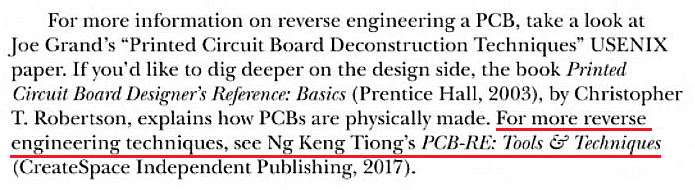
This blog contains many snippets of the content in my books to provide a more detailed overall sampling for my would-be readers to be better informed before making the purchase. Of course, the book contains more photos and nice illustrations, as evidence from its cover page. Hopefully, this online trailer version will whet your appetite enough to want to get a copy for yourself.

Top Review

I started doing component level repair of electronics with (and without) schematics more than 40 years ago, which activity often involves reverse-engineering of printed circuit boards. Although over the years my technical interests have shifted into particle beam instrumentation, electron microscopy, and focused ion beam technology fields, till this day——and more often than not——PCB repairs have returned multiple multi-million-dollar accelerators, FIB, and SEM instruments back to operation, delivering great satisfaction and some profit.

Many of the methods described by Keng Tiong in great details are similar to the approaches I've developed, but some of the techniques are different, and as effective and useful as efficient and practical. Systematic approach and collection of useful information presented in his books are not only invaluable for a novice approaching PCB-level reverse engineering, but also very interesting reading and hands-on reference for professionals.

Focus on reverse engineering instead of original design provides unique perspective into workings of electronics, and in my opinion books by Keng Tiong (I've got all three of them) are must-read for anybody trying to develop good understanding of electronics——together with writings by Paul Horowitz and Winfield Hill, Phil Hobbs, Jim Williams, Bob Pease, Howard Johnson and Martin Graham, Sam Goldwasser, and other world's top electronics experts.

Valery Ray
Particle Beam Systems Technologist

Saturday, May 21, 2022

Active Discrete - Transistors

If two is company, then three is a crowd——unless it happens to be a transistor. In the early days, this term is almost always associated with the germanium or silicon based maverick that has permeated into every electronic devices since its inception. Today, it's a different story altogether.

The transistor story, however, can be traced as far back to the era of the thermionic valves. I remember well the first lesson I had in my secondary school days was the theory and operation of the venerable triode. Talk about big brother!

Walter Brattain, John Bardeen and William Shockley of the Bell Telephone Laboratories might have been proud of their breakthrough when they came up with the first transistor prototype, but I believe Sir John Ambrose Fleming should be credited with the invention of the thermionic valve which ultimately led to the birth of the transistor four decades later.

Today's engineers certainly walk on the shoulders of these giants of bygone years.

Monday, May 16, 2022

Active Discrete - Diodes

I suppose the most common active discrete components that electronic engineers are familiar with should be the versatile diode:

For a simple two-terminal dual junction semiconductor device with non-linear electrical properties, it may come as a surprise that there are literally a bunch of variants exhibiting different characteristics and used in varied applications.

Considering the fact that the diode had existed since the cold war era as a vacuum tube entity, imagine the progress it has made to arrive at the forms that it is today:

What will the future hold for semiconductor electronics as wafer technology and manufacturing reaches its physical limits? Nobody knows. One thing is for sure——diodes are here to stay for quite a while. As they said, "You've come a long way, baby!"


Friday, May 6, 2022

Nostalgic Fontasy

When I wrote my first engineering book on the PCB-RE subject, I was more focused on the content than the presentation, and took little notice of the font type and style. As a result, some would-be buyers were turned away by the 10-point Calibri typeface which, though not a bad font, is rather uncomfortable to read for those with myopia issue. (To be honest, this fact had been bugging me for quite a while but I just did not have the time to address it and put it to rest.)

Subsequently, when I wrote the sequel and trilogy, I changed the font to a 12-point Franklin Gothic Book typeface which is easier on the eyes for those preferring printed copies. But I still retain the old format for 'The Art' book out of nostalgic sentiments. After all, it is my very first piece of work. Seven years down the road, I decided that a facelift is due so without much fanfare, I did a revamp and changed the font type to Franklin Gothic Book as well. This will ensure consistency for all my PCB-RE series. Here is a side-by-side comparison sample page:

I have also re-done the book cover (front and back):

Those who bought my original edition can take comfort in knowing they now own a 'limited edition' that is no longer in circulation. (Heck, it might become a collector's item in a few years time, who knows?) For those who have yet to get a copy of 'The Art' book, this change might just be the nudge you need.

Now I can finally put this behind me and get back to writing my next engineering book...

Saturday, April 30, 2022

Passive Discrete - Inductors

Back to basics (covered in Deciphering Schematics):

Resistors, capacitors, and inductors are primary types of passive discrete components. In their most basic form, they come with two-terminals, through-hole or SMD. The chart below shows the types of inductors:

Inductors are coils with one or more windings of conductive wire wrapped over a medium (air, ferrite, etc.). Current flowing through an inductor induces a magnetic field that serves as a storage of energy (i.e., Eb = -L[ΔI/Δt]). It also generates a counter electromotive force (plus induced current) that restricts the flow of alternating current while allowing direct current to pass through. 


Thursday, April 28, 2022

Passive Discrete - Capacitors

Back to basics (covered in Deciphering Schematics):

Resistors, capacitors, and inductors are primary types of passive discrete components. In their most basic form, they come with two-terminals, through-hole or SMD. The chart below shows the types of resistors:

Capacitors has the ability to store electrical charge exponentially, the amount of charge being determined by the capacitance value and the voltage applied across the device (i.e., Q = CV). One important use of capacitors is passing alternating current while blocking direct current, also known as ‘AC coupling’.


Wednesday, April 27, 2022

Passive Discrete - Resistors

Back to basics (covered in Deciphering Schematics):

Resistors, capacitors, and inductors are primary types of passive discrete components. In their most basic form, they come with two-terminals, through-hole or SMD. The chart below shows the types of resistors:

Resistors oppose (restrict, limit) the flow of current and are employed to control current and manage voltage levels in a circuit. The relationships between resistance, voltage and current conform to Ohm’s Law such that current is proportional to the applied voltage and inversely proportional to the resistance (i.e., V = IR).


Saturday, April 16, 2022

A Special Birthday Request

Two days ago, I celebrated my wife's birthday. She did not ask for anything fanciful or expensive, just something simple: kite flying. So I bought her a beautiful butterfly kite that could be easily self-assembled and we went to a nearby coastal park after breakfast to fly it. Thankfully the weather was sunny with a cool breeze, which made kite flying a breeze (pun intended).

See how happy and delighted she was? That's the simple pleasure of life!

As it was a weekday, there were not many people around so we literally had the whole field to ourselves, which was kinda nice. Since the kite was on 'auto-pilot' we decided to sit near the shoreline and listen to the waves splashing while enjoying some quiet moments together. A few passers-by seemed absorbed with the quiet fun we're having, and one even requested to take a snapshot for us. For lunch, I treated her to a vegan Thunder Tea rice.

It's my way of showing appreciation and saying thanks to her for being supportive of my writing journey the past six years, this year being the seventh and probably the last. Thanks, my love, for being there and encouraging me to fulfil my dream and passion as an author!

Tuesday, April 12, 2022

A Worthy Mention

Books on hardware hacking are on the popular rise and there are a few notable titles that aspiring hackers can learn from. One book, in particular, is The Hardware Hacker's Handbook by Jasper van Woudenberg, which is really about overcoming embedded security.

I'm not giving a review here, in case you're wondering; rather, I was surprised and delighted that the author of this best seller mentioned my sequel, PCB-RE: Tools & Techniques in Chapter 3 (page 106) of his book, which I have produced and highlighted below:

It's always a nice feeling when your work is noticed by another author, a practice I engaged in my own writings to point interested readers to useful sources who want to learn more about a particular related topic. As always, the first and sequel PCB-RE books seem to be a natural choice for those starting out in their PCB-RE journey.

Writing engineering books is hard work that doesn't guarantee success unless there are good reviews and wide publicity from readers and supporters. So I'm counting on you, my friends, to spread the word and help recommend my books. Thanks in advance!

Monday, April 11, 2022

Spoiler Alert!

If there's anything to indicate what you'd be getting from Deciphering Schematics, besides nicely drawn (and well-proportioned) schematic diagrams, there will also be beautiful illustrations such as that found in the following two-page sample from Chapter 5:

Sure, it's going to cost me time and effort to come up with all these vector-based drawings. As an author who writes engineering books that bear my name, I'm not about to let poor reading experience leave a black mark on my hard work. I want readers who buy my books to be assured of the best quality, knowing they are worth every cent of it. And I certainly hope readers will give me the assurance in kind through honest purchases too.

But I can only leave it to personal integrity and just do my part well. In the end, as they say, everything will even out. Meanwhile, stay safe and well, my friends.

Thursday, April 7, 2022

Update on Chapter 5

Been working relentlessly on this chapter for the past couple of weeks and nearing completion. By far, this is the most interesting chapter to write. I've covered quite a bit on the elements of analog circuits, from the issues of discrete versus integrated, passive versus active, and mechanical versus solid-state, on to circuit topologies involving transistors, MOSFETs and operational amplifiers.


Trying to cover every aspect of analog circuits is near impossible, so I choose to highlight the essentials and what topologies best represent the elements discussed. Hopefully readers will catch on and expand on what they have learned to further enrich their understanding in deciphering schematics. Of course, I will follow on with a chapter that showcase a full-blown analog circuit and how to go about making sense of its functionalities and design. After all, what is theory if there is no practice, right?

As to why I decided to write this book before PCB Diagnostics (which I started out after completing the PCB-RE series) is because I realize that understanding circuit diagrams is an important key to repairing circuit boards. For readers who have no foundation in electronics, this book will give a good overview of what constitute digital, analog and hybrid circuit designs, with an added bonus on power supply circuits.

It should be a book worth waiting for, though it's by no means easy on my part to write it, coming from the perspective of someone wishing there is a better way to be given a broad overview of electronics  (interesting and informative enough without all the nitty-gritty details) and the know-how in decoding the blueprint that made up these circuits.

Friday, March 18, 2022

Analog Circuits

Now that I've completed the section on deciphering digital circuits, it's time to move on to something more interesting and different——analog circuits. As you would probably know by now, my style of writing is geared towards engaging the readers so I tend to use metaphors here and there to bring out certain concepts for better clarification or understanding. Here's the introduction to the next section of my book:

If you'd notice, even the choice of fonts is intentional to intrigue my readers. After all, it's about deciphering, get it? I'm a perfectionist and I'll spare no effort in making sure that each book I write bears the mark of my craftsmanship, which is why I'd painstakingly draw (and redraw) my illustrations in Visio for the best picture quality possible.

For the amount of time and effort put in, it should be worth every cent readers paid for my books. All I ask is for those who believe in rewarding hard work to support authors like me with honest purchase——not shortchange or steal my months of sweat and toil. Someone once said:

If it costs you peace of mind and your conscience, the price is too high.

So do yourself a favor by doing what is right. 


Tuesday, March 15, 2022

Update on Chapter 4

I've completed Chapter 4 of the book Deciphering Schematics. Besides going through a 3-page MCU-based schematic diagram, I've added a bonus section that showcase a CPLD circuit:

Now, I need to make it clear that I'm teaching readers how to decipher a circuit. It is beyond the scope of this book to teach CPLD programming, so don't expect any lesson on hardware description language or how to program FPGAs. There are plenty of resources available online that readers can easily find and learn from, whether in written form or video tutorial.

Nonetheless, I do make recommendations every now and then on useful resources that are related to the topics I'm illustrating or discussing. Hopefully, that will supplement what this book does not cover and allow interested readers to pursue further on the subjects at hand.

That's all for this short update.

Friday, March 11, 2022

Out of the Woods, Finally...

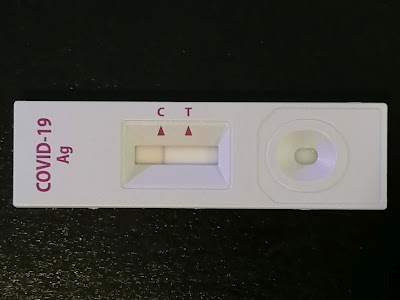
Since contracted the Omicron variant two weeks ago, we were basically out of action for one week due to symptoms of fever, cough, and muscle aches for myself. One week into recovery, we did another ART as instructed in the protocol. My wife came up negative but I was still positive, albeit the T line was much fainter:

Today, after 14 days and feeling much better without any more symptom, I did an ART after breakfast. This time I am finally cleared and good to go:

While the Omicron symptoms are considered 'mild' compared to the Delta variant, it still feels terrible once you are down with it. Having to struggle with body fatigue while working on my book is certainly no small feat. The physical discomfort does affect the mental capacity.

Thankfully with this episode behind me, I hope to catch up on lost time.

Sunday, February 27, 2022

Covid-19 Positive!

Ever since Singapore announced an endemic (living with Covid-19) policy with relaxed measures and opening up of borders through VTLs, the onset of Omicron has seen a marked increased in the daily cases of infection, though mostly with mild symptoms. Our health minister even preempted that it's only a matter of time before any of us will get it.

Last Friday, I woke up with body aches and a slight feverish feeling, so decided to do an Antigen Rapid Test (ART). It turned out positive. My wife did hers and the results confirmed that both of us are down with Covid-19.

According to the latest health protocol, it has to be 72 hours before we do another ART to assess if we are OK or need to serve a longer home recovery program.

Hopefully, at least one of us will be negative so we do not need to trouble our friends to help us get the groceries and meals. The so-called mild symptoms are not in anyway trivial as we experience coughs, vacillating fevers and muscle aches. I could only manage to do a bit of writing but most of the time I'm down and out due to fatigue from fighting the virus, despite having been vaccinated.

That's all for the update. Mind's a bit foggy right now...

Thursday, February 24, 2022

Deciphering Digital Circuits

Starting a new chapter on this topic. I intended to illustrate using two real-world examples: a MCU-based mixed design and a CPLD experimental board. Here's the introduction page:

It's not easy to cover every aspect of digital circuits. My focus is more on understanding and making sense of a schematic diagram, rather than how to be a hardware or firmware designer, which itself is a subject that can fill a volume or more. So it's important to manage your expectations.

Chapter 3 will also contain quite a lot of information on various digital circuit design aspects, which you might already have some idea based on my previous posts. Hopefully, these should cover enough ground on the digital aspect of schematic diagrams.

Thursday, February 17, 2022

Progress Update

The start of a new year has always been busy with tight schedules, more so with the constant changes in government policies over the evolving pandemic situation. Thankfully, after a hectic Lunar New Year saga, I am able to sit down once again and resume writing.

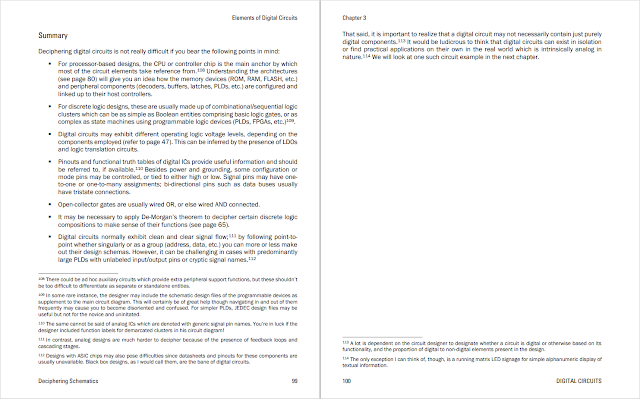
Finally, completed Chapter 3: Elements of Digital Circuits for my book, Deciphering Schematics. Here is the Summary page at the chapter's end:

I've outlined nine chapters plus several appendices for this book, so at 100 pages currently, I foresee it will probably run up to 250 pages or more when it's completed. I still have the other book, PCB Diagnostics, at the back of my mind but somehow I don't seem to have the motivation to work on it, yet.

Again, this year being the seventh and likely final year for me in book writing as an author, I do hope to at least finish one of them before I call it quit. If I can write both, that will be a bonus for my readers. That will be six engineering books in total, which accounts for about 60% of my knowledge and experience. I don't foresee that I will go beyond that, unless there are very good reasons to. Still, I'm thankful to my wife for her patient support and belief in my hard work.

That's all for now. Stay safe and well, my friends.

Monday, February 7, 2022

Universal Serial Bus

The Universal Serial Bus (USB) is perhaps one of the most versatile and common serial bus protocol ever to be implemented in modern digital technology, from computers to storage devices and mobile gadgets that we hold in our hands. But what makes them so popular and universally adopted compared to the other types of serial buses?

The answer lies in one of the greatest features of the USB—hot swapping. This feature allows a device to be removed or replaced without the past prerequisite of rebooting and interrupting the system. Older ports required a PC to be restarted when adding or removing a new device. Hot swapping is fault-tolerant—the ability to continue operating despite a hardware failure. That said, when hot-swapping certain devices such as a camera, damage can occur to the port, camera or other devices if a single pin is accidentally shorted.

Since its inception, the USB has undergone several revisions, not only to improve on the speed of data transfer rates, but also to adapt to smaller designs and the multi-functional requirements of today's powerful computing platforms.

So while SPI, I2C, CAN and the RS family of serial buses have their own specialized usage in certain industrial and design applications, we can be sure that the USB will remain a top favorite when it comes to plug-and-play and on-the-go user experience for a long time to come.

Tuesday, February 1, 2022

Year of the Tiger

According to the Chinese zodiacs, 2022 is the year of the Tiger. As the pandemic rages on, people wonder if it will go on indefinitely, or will this king of the mountain put a stop to it and restore some normalcy to daily life once again?

Reminds me of a poem by the English poet William Blake:


We'll never know for sure what 2022 and beyond holds for all of humanity. One thing I do hope is that as we move ahead, we will have the courage and resolve of the Tiger to face whatever challenges, knowing that we're not alone in this journey.

Those who are into PCB-RE will know what it takes to overcome the odds. For those who aren't, why not consider getting a copy of my books and begin this extraordinary journey of a lifetime? I'm sure it will not only enrich your engineering experience but your overall outlook of life as well.

Stay safe and strong, my friends!

Friday, January 28, 2022

PCB Repair

A friend of mine who is in the PCB repair industry, representing ABI Electronics as a field support engineer to train customers on how to use their range of test and troubleshooting products, wrote the following post on his LinkedIn account:

Thought I'd join in the fun and share my two cents' worth:

The term PCB repair is more involved than just testing component or diagnosing faults. From my 30 years experience in this endeavor, I learned that you need to acquire the following skills of the trade:

1.  Conformal removal and reapplication
2.  Board and component test
3.  Fault diagnostic and troubleshooting
4.  Schematic analysis (if available)
5.  Partial or full PCB reversing (if unavailable)*
6.  Soldering and rework
7.  Component identification and handling

The fifth point is necessary if the board is burnt or suffered physical damage that impacted its electrical integrity. PCB-RE is especially useful in the absence of schematic diagrams.


Sunday, January 16, 2022

Trilogy on Show at CMTS

It's not often that an obscure writer gets his book mentioned at a large technology show, but that's what happened to my trilogy book, PCB-RE: Real-World Examples. The CMTS is Canada's national stage for manufacturing technologies, best practices and industry connections, and the ENA President Mr Gabe Del Bello was invited to speak on the topic of PCB Reverse Engineering. Now that's cool!

In the very first slide, he showcased my book and encouraged those interested in this niche topic to get a copy and find out for themselves what PCB-RE entails. You can click on the snapshot below to go to YouTube and hear his presentation.

Mr Gabe's endorsement can be found at the 5:40 mark.

For those who already have some basic understanding regarding PCB-RE, this IS the best book to get a feel of what real-world practices is really like. To preview its content, click on the book cover at the right of this blog to go to Amazon store.


Ps: Thanks to Marc Hickling for notifying me about this presentation. He's one of the contributors in the trilogy book, and in the chapter attributed to his work he gives a glimpse of ENA Electronics Inc. PCB-RE business process and showcase several examples of successful projects involving obsolete PCBs. As what Mr Gabe would say, "We support the unsupportable."


Wednesday, January 12, 2022

Coming in Third

I don't usually bother about how my blog fairs compared to the other well-known and better branded ones. Occasionally, though, I would take a glimpse just to have a feel if what I posted is receiving good readership. Here's the standing from blog.feedspot.com:

Out of the top 25 PCB-related blogs and websites, mine came in third. Now, that's kinda reassuring indeed!


Tuesday, January 4, 2022

No CAN Do!

I have a friend who gets exasperated whenever someone talks to him in American slang. One of the issues he had was figuring out if the other party is in the affirmative or not whenever he asked, "Can you do this for me?" There's a subtle nuance that differentiates between "I can" and "I can't" that's hard for him to detect due to his hearing, he'd follow with another question, "So can you, or can you not?" just to be sure.

Given a choice, I suspect my friend would prefer a "No can do" over "I can't" for a reply. I think the phrasing is meant to imply simplified English, as if speaking to a non-native speaker. The proper usage should be "No, can't do" but people just got lazy and omit the 't' sound altogether. Then again, the other party may be implying, "It might be possible, but I'm not willing to try." So it's anybody's guess. 

Thankfully, the CAN bus has its own way of arbitration for devices sharing just two common data lines:


After so many years, I wonder if that friend has gotten over this matter. Should I bump into him one day, I may just suggest to him to read up the CAN protocol and see if that helps.

CAN do? You betcha!

Saturday, January 1, 2022

Happy 2022

2021 has been a challenging yet enriching year for me. I hope it had been the same for you. As we enter into 2022, let's make it a better year not only for ourselves but also for our loved ones, friends and even those who may cross our paths.

Wishing all my readers a safe, healthy and happy 2022!

Oh, by the way 2022 sounds like "2020 too"... but don't worry about it, I'm sure we'll all do just fine if we keep our heads high and put our hearts where it should be, in the right place and for the right reasons. We should be OK then (grin!).


Friday, December 31, 2021

New Year's Eve

The year 2021 is coming to a close in about 12 hours time (Singapore). As cities around the world bid farewell to another year of pandemic, and people gather for the final countdown to usher in a new year, celebrating with families and friends to have made it this far, and wishing one another better times ahead, I would like to share a photo of my city-state with my readers: 

The brilliant fireworks set against the famous landmarks of the Marina Bay Sands (left), the Art-Science Museum (center)  and the Singapore Flyer (right), all over the Marina Bay area, is a reflection and reminder that life can still be beautiful if we learn not to take it for granted, but live with gratitude and appreciation for the nature and nice people around us.

Let me leave you with the familiar tune of the following song:

Should auld acquaintance be forgot,
and never brought to mind?
Should auld acquaintance be forgot,
and auld lang syne*?

Chorus:
For auld lang syne, my jo,
for auld lang syne,
we'll tak' a cup o' kindness yet,
for auld lang syne.

Take care and see you next year!

Wednesday, December 29, 2021

The Art of Communication

Communication is key, whether it's in a relationship, workplace or between strangers. To carry on a meaningful conversation there must be some kind of common understanding and language, much like a standard protocol between the two parties.

The same goes for devices in a circuit board or client-server in a cloud or network. Information can transfer at high speed or just occasional casual exchanges, depending on the applications they are designed for. One of most commonly found communication links is the serial bus:

Even so, you may be surprised to know that there are quite a number of protocols, grouped into  two camps: synchronous and asynchronous. Of course, faster is not necessary better as it depends on your design requirements.

Still, it is good to know the popular ones if you want to make sense of the schematic you're deciphering. It's not that difficult, though. I'll show you how in this upcoming book. Don't ask me when it's coming out because I haven't the faintest idea. Maybe by the end of the first quarter next year.

Just keep a look out for my progress updates on this blog.