To My Readers


If this is the first time you're visiting my blog, thank you. Whether you're interested or just curious to find out about PCB reverse engineering (PCB-RE), I hope you'll find something useful here.

This blog contains many snippets of the content in my books to provide a more detailed overall sampling for my would-be readers to be better informed before making the purchase. Of course, the book contains more photos and nice illustrations, as evidence from its cover page. Hopefully, this online trailer version will whet your appetite enough to want to get a copy for yourself.

Top Review

I started doing component level repair of electronics with (and without) schematics more than 40 years ago, which activity often involves reverse-engineering of printed circuit boards. Although over the years my technical interests have shifted into particle beam instrumentation, electron microscopy, and focused ion beam technology fields, till this day——and more often than not——PCB repairs have returned multiple multi-million-dollar accelerators, FIB, and SEM instruments back to operation, delivering great satisfaction and some profit.

Many of the methods described by Keng Tiong in great details are similar to the approaches I've developed, but some of the techniques are different, and as effective and useful as efficient and practical. Systematic approach and collection of useful information presented in his books are not only invaluable for a novice approaching PCB-level reverse engineering, but also very interesting reading and hands-on reference for professionals.

Focus on reverse engineering instead of original design provides unique perspective into workings of electronics, and in my opinion books by Keng Tiong (I've got all three of them) are must-read for anybody trying to develop good understanding of electronics——together with writings by Paul Horowitz and Winfield Hill, Phil Hobbs, Jim Williams, Bob Pease, Howard Johnson and Martin Graham, Sam Goldwasser, and other world's top electronics experts.

Valery Ray
Particle Beam Systems Technologist

Monday, February 7, 2022

Universal Serial Bus

The Universal Serial Bus (USB) is perhaps one of the most versatile and common serial bus protocol ever to be implemented in modern digital technology, from computers to storage devices and mobile gadgets that we hold in our hands. But what makes them so popular and universally adopted compared to the other types of serial buses?

The answer lies in one of the greatest features of the USB—hot swapping. This feature allows a device to be removed or replaced without the past prerequisite of rebooting and interrupting the system. Older ports required a PC to be restarted when adding or removing a new device. Hot swapping is fault-tolerant—the ability to continue operating despite a hardware failure. That said, when hot-swapping certain devices such as a camera, damage can occur to the port, camera or other devices if a single pin is accidentally shorted.

Since its inception, the USB has undergone several revisions, not only to improve on the speed of data transfer rates, but also to adapt to smaller designs and the multi-functional requirements of today's powerful computing platforms.

So while SPI, I2C, CAN and the RS family of serial buses have their own specialized usage in certain industrial and design applications, we can be sure that the USB will remain a top favorite when it comes to plug-and-play and on-the-go user experience for a long time to come.

Tuesday, February 1, 2022

Year of the Tiger

According to the Chinese zodiacs, 2022 is the year of the Tiger. As the pandemic rages on, people wonder if it will go on indefinitely, or will this king of the mountain put a stop to it and restore some normalcy to daily life once again?

Reminds me of a poem by the English poet William Blake:


We'll never know for sure what 2022 and beyond holds for all of humanity. One thing I do hope is that as we move ahead, we will have the courage and resolve of the Tiger to face whatever challenges, knowing that we're not alone in this journey.

Those who are into PCB-RE will know what it takes to overcome the odds. For those who aren't, why not consider getting a copy of my books and begin this extraordinary journey of a lifetime? I'm sure it will not only enrich your engineering experience but your overall outlook of life as well.

Stay safe and strong, my friends!

Friday, January 28, 2022

PCB Repair

A friend of mine who is in the PCB repair industry, representing ABI Electronics as a field support engineer to train customers on how to use their range of test and troubleshooting products, wrote the following post on his LinkedIn account:

Thought I'd join in the fun and share my two cents' worth:

The term PCB repair is more involved than just testing component or diagnosing faults. From my 30 years experience in this endeavor, I learned that you need to acquire the following skills of the trade:

1.  Conformal removal and reapplication
2.  Board and component test
3.  Fault diagnostic and troubleshooting
4.  Schematic analysis (if available)
5.  Partial or full PCB reversing (if unavailable)*
6.  Soldering and rework
7.  Component identification and handling

The fifth point is necessary if the board is burnt or suffered physical damage that impacted its electrical integrity. PCB-RE is especially useful in the absence of schematic diagrams.


Sunday, January 16, 2022

Trilogy on Show at CMTS

It's not often that an obscure writer gets his book mentioned at a large technology show, but that's what happened to my trilogy book, PCB-RE: Real-World Examples. The CMTS is Canada's national stage for manufacturing technologies, best practices and industry connections, and the ENA President Mr Gabe Del Bello was invited to speak on the topic of PCB Reverse Engineering. Now that's cool!

In the very first slide, he showcased my book and encouraged those interested in this niche topic to get a copy and find out for themselves what PCB-RE entails. You can click on the snapshot below to go to YouTube and hear his presentation.

Mr Gabe's endorsement can be found at the 5:40 mark.

For those who already have some basic understanding regarding PCB-RE, this IS the best book to get a feel of what real-world practices is really like. To preview its content, click on the book cover at the right of this blog to go to Amazon store.


Ps: Thanks to Marc Hickling for notifying me about this presentation. He's one of the contributors in the trilogy book, and in the chapter attributed to his work he gives a glimpse of ENA Electronics Inc. PCB-RE business process and showcase several examples of successful projects involving obsolete PCBs. As what Mr Gabe would say, "We support the unsupportable."


Wednesday, January 12, 2022

Coming in Third

I don't usually bother about how my blog fairs compared to the other well-known and better branded ones. Occasionally, though, I would take a glimpse just to have a feel if what I posted is receiving good readership. Here's the standing from blog.feedspot.com:

Out of the top 25 PCB-related blogs and websites, mine came in third. Now, that's kinda reassuring indeed!


Tuesday, January 4, 2022

No CAN Do!

I have a friend who gets exasperated whenever someone talks to him in American slang. One of the issues he had was figuring out if the other party is in the affirmative or not whenever he asked, "Can you do this for me?" There's a subtle nuance that differentiates between "I can" and "I can't" that's hard for him to detect due to his hearing, he'd follow with another question, "So can you, or can you not?" just to be sure.

Given a choice, I suspect my friend would prefer a "No can do" over "I can't" for a reply. I think the phrasing is meant to imply simplified English, as if speaking to a non-native speaker. The proper usage should be "No, can't do" but people just got lazy and omit the 't' sound altogether. Then again, the other party may be implying, "It might be possible, but I'm not willing to try." So it's anybody's guess. 

Thankfully, the CAN bus has its own way of arbitration for devices sharing just two common data lines:


After so many years, I wonder if that friend has gotten over this matter. Should I bump into him one day, I may just suggest to him to read up the CAN protocol and see if that helps.

CAN do? You betcha!

Saturday, January 1, 2022

Happy 2022

2021 has been a challenging yet enriching year for me. I hope it had been the same for you. As we enter into 2022, let's make it a better year not only for ourselves but also for our loved ones, friends and even those who may cross our paths.

Wishing all my readers a safe, healthy and happy 2022!

Oh, by the way 2022 sounds like "2020 too"... but don't worry about it, I'm sure we'll all do just fine if we keep our heads high and put our hearts where it should be, in the right place and for the right reasons. We should be OK then (grin!).


Friday, December 31, 2021

New Year's Eve

The year 2021 is coming to a close in about 12 hours time (Singapore). As cities around the world bid farewell to another year of pandemic, and people gather for the final countdown to usher in a new year, celebrating with families and friends to have made it this far, and wishing one another better times ahead, I would like to share a photo of my city-state with my readers: 

The brilliant fireworks set against the famous landmarks of the Marina Bay Sands (left), the Art-Science Museum (center)  and the Singapore Flyer (right), all over the Marina Bay area, is a reflection and reminder that life can still be beautiful if we learn not to take it for granted, but live with gratitude and appreciation for the nature and nice people around us.

Let me leave you with the familiar tune of the following song:

Should auld acquaintance be forgot,
and never brought to mind?
Should auld acquaintance be forgot,
and auld lang syne*?

Chorus:
For auld lang syne, my jo,
for auld lang syne,
we'll tak' a cup o' kindness yet,
for auld lang syne.

Take care and see you next year!

Wednesday, December 29, 2021

The Art of Communication

Communication is key, whether it's in a relationship, workplace or between strangers. To carry on a meaningful conversation there must be some kind of common understanding and language, much like a standard protocol between the two parties.

The same goes for devices in a circuit board or client-server in a cloud or network. Information can transfer at high speed or just occasional casual exchanges, depending on the applications they are designed for. One of most commonly found communication links is the serial bus:

Even so, you may be surprised to know that there are quite a number of protocols, grouped into  two camps: synchronous and asynchronous. Of course, faster is not necessary better as it depends on your design requirements.

Still, it is good to know the popular ones if you want to make sense of the schematic you're deciphering. It's not that difficult, though. I'll show you how in this upcoming book. Don't ask me when it's coming out because I haven't the faintest idea. Maybe by the end of the first quarter next year.

Just keep a look out for my progress updates on this blog. 

Saturday, December 25, 2021

What is Christmas to You?

People all over the world celebrate Christmas, but this special season means different things to different people. Even so, there is something magical and magnetic about Christmas that draws people to it. As the year comes to a close and everyone put aside their work and worries, there is this anticipation of something good, something better that will perhaps wash away all the accumulated unhappiness and unpleasant experiences, and bring about a new beginning with new promises.

Yes, there is something about Christmas that seems to bring joy to the weary spirit, a kind of love that warms and lifts the heavy-hearted, and a renewed hope that puts a smile on the tear-stained face. It could be the festive mood, the colorful decorations, the angelic carol voices, and the gifts that you receive.

More importantly, Christmas is not just a holiday or an event to be celebrated. Christmas is really about a Person (not Santa Claus, of course!) whose name is imprinted in the very word itself. Give it some thought and ponder the wonder of its significance. It may just make this Christmas different and deeply meaningful than what you have ever known...


Tuesday, December 21, 2021

MCU - It's Not What You Think

These days, when people see the acronym 'MCU' they'll associate it with 'Marvel Cinematic Universe', thanks to the series of movies like 'X-Men' and 'The Avengers'. For electronic engineers, 'MCU' simply stands for 'Microcontroller Unit', one of many branches of the processor universe.

In fact, just like the Nine Realms mentioned in the 'Thor' movie and its spin-offs, there are also various realms or architectures of processors (some say there are five while others claim there are ten). And like the 5000-year convergence that remove the boundaries between the Nine Realms, processors are also gradually blurring their lines of distinction.

The latest incarnation is RISC-V, an ISA based on reduced instruction set computer (RISC) principles, but unlike most other ISA designs, it is provided under a open source license that does not require fees to use. This is significant because it will allow smaller device manufacturers to build hardware without paying royalties and allow developers and researchers to design and experiment with a proven and freely available instruction set architecture. It will also encourage innovation and competition at a time when many large manufacturers are buying up their competitors, such as the recent acquisition of Arm Ltd by Nvidia.

But I'm not sure if that is the finality of the processor evolution, just as Thanos mistakenly bragged "I am inevitable" only to find out that he had lost all his marbles (stones) to Tony Stark with the last words, "And I am Iron Man!"

Monday, December 13, 2021

The Matrix Reprogrammed

Since it's debut in 1999, The Matrix has spun two successive movies four years later, a sequel (The Matrix Reloaded) and a trilogy (The Matrix Revolutions). It's latest incarnation, The Matrix Resurrections came almost after a 20-year absence, re-igniting interest in this topic. But will the storyline and special effects deliver?

I'll have to admit, it took a while for me to figure out the concept behind The Matrix when I first watched it. Special effects aside, the idea that reality is simulated in the brain instead of lived out in the body seemed far-fetched back then. Not anymore in this age of the Metaverse, where virtual reality (VR) and augmented reality (AR) began to blur the line of distinction between what is real and imaginary. Kinda scary, isn't it?

The Matrix, however, has been around even before it came onto the silver screen. We electronic engineers encounter them on a daily basis, in the form of programmable logic devices:

Whether it's factory or field programmable, from the early days of PROM all the way to today's complex FPGAs, The Matrix continues to re-invent itself (not just reloaded or revolutionized). Heck, if resurrections is anything to go by, it'll probably be a retrospection of past technologies rejuvenated by today's advances in science and a fair bit of fiction.

And that's a whole bunch of 'Re-'s if you care to count...

Wednesday, December 8, 2021

Conjunction, Disjunction, Negation

Language can be confusing when it comes down to difficult terms like these words in the post title. Makes you wonder if there's a simpler and better way to put it so even the man on the street can understand. That's where the Boolean lingo shines——conjunction (AND), disjunction (OR), negation (NOT). When it comes to simplifying logic circuits, you have De-Morgan to thank, too.

Not everyone agrees, though. And for obvious (pun intended) reasons. It may take you a while to figure but once the light bulb turns on, the rest as they say, is history.


Monday, December 6, 2021

Reset, ReSET, RESET...!!!

I'm not much of a fan of the World Economic Forum, an international non-governmental and lobbying organization that meddles with the economic affairs of the world. Since the start of the CoVid-19 pandemic it's founder, Klaus Schwab, has been entertaining the possibility of a Global Reset, a move that he believes will help bridge the gap between the rich and the poor. But not many people buy into his idea, especially his wry remark:

Seriously, we'll own nothing and be happy? 50 years on since founding the WEF (or as some people say, WTF), he may be close to realizing his dream of owning a large part of the world with the rest of the global elites, while the rest of us are expected to loan the earth from 'them', our masters. This is one BIG RESET I would rather not see happen.

The only kind of reset that is of real benefit is the PoR i.e. 'Power on Reset'. Most electronics and computer systems depend on it to function properly and predictably, though getting the charge-up time correctly is a matter of trial and error.

Now, if only there's a Re-SET that can redistribute the wealth of these greedy globalists to the needy and hardworking people of the world, that would be nice, isn't it? We just need to find THAT switch to the MARTIX...


Friday, December 3, 2021

Visio Alternatives?

I've been asked a number of times by readers whether there's any open source Visio alternatives out there, and I can understand why—a single user license doesn't come cheap even for a Standard version. Of course, there are many so-called free alternatives (not necessary open source, though) that claim to be  equal to or better than Microsoft Visio. Some are cloud-based, online kind of diagramming editors that do not need to be installed, while others offer free download of their most basic products with limitations for you to try before you buy.


At best, if you ask me, these alternatives are nothing more than your usual run-of-the-mill diagramming tools with colorful and attractive templates for drag-and-drop style presentation and illustration purposes only. When it comes to creating serious engineering drawings, their arsenal of drafting tools prove to be rather basic and primitive.

In my years of using Visio, right from the start with version 4.1 Technical from Shapeware, to this present time with Visio 2016, there is never a doubt in my mind that nothing (and I mean NOTHING) out there comes close to the power and usability of this amazing piece of software. How many of these Visio wanna-be spot the following features:

        1. Multiple-page support per drawing file
        2. Layering of shapes
        3. Smartshapes and Shapesheet programmability
        4. Bill of Materials report generation

Most Visio alternatives failed on just the first feature alone. And if you have bought my PCB-RE books you would no doubt have firsthand experience of what it's capable of through the many examples that I've demonstrated.

If the full license is too high upfront, you can opt for Microsoft's monthly plans of $5 for a web-based version which is synced to Onedrive, or $15 for an additional desktop install version. This can be tied to your Office 365 subscription without bursting your bank account. In fact, Microsoft offers a free 30-day trial of its latest version. Click on Evaluate Visio to go to the site.

So go ahead, give Visio a try and see if it's the best and only diagramming tool you'll ever need.

Thursday, November 25, 2021

A Word of Thanks

Thanksgiving is a special season. It brings to mind the wonderful people we meet and the beautiful times and memories we had throughout the year. And as we gather with family and friends over a sumptuous feast, we can't help but be thankful, that despite the pandemic that has ravaged for the past two years, two things still remain close and precious to our hearts——family and friendships.

While Thanksgiving Day is not a national holiday in my country, I want to take this opportunity to thank all my readers——those who have supported my works and left glowing reviews to spur me on in this journey which I started six years ago. Your honest purchase of my books has made it possible for me to continue writing and giving to charities, however meager by comparison to other renown authors. Still, it's the thought that counts, isn't it?

It is my hope that the knowledge and experience I put into print will benefit the electronics community for many years to come. As each generation of engineers embark on this challenging yet rewarding adventure of doing PCB-RE, may they hear the faint echo of this obscure writer cheering them onwards to master this niche and coveted skillset, long after he is gone.

Happy Thanksgiving Day, my readers! Stay safe and well throughout this festive seasons...

Monday, November 22, 2021

By George!

Happened to catch a re-telecast of Ocean's Thirteen on TV late last night. The plot was interesting and the cast of characters quite entertaining. But those who watched Steven Soderbergh's Ocean trilogy must admit that lead actor George Clooney who played Danny Ocean displayed a personal charm that had audiences captivated throughout the show, notwithstanding appearances by heavyweights like Al Pacino, Brad Pitt and Matt Damon.

The attempt to pull a heist over The Bank, Al Pacino's greatest and most advanced casino, run by an AI central control and surveillance system codenamed Greco, which even The Malloy Brothers believed was unbroachable, spun out a series of strategies that ultimately saw the team made off with half a billion in winnings and a quarter billion in diamonds.

A movie is just that—pure entertainment—if there is no takeaway after viewing and reviews. Strategies aside, I believe the success of a team is dependent on the participation of every player. More importantly, though, the charisma of a leader is the glue that gels the team and at the same time gives leeway for team members to be at their best in the roles and tasks assigned.

Do you have what it takes to be an Ocean, or the top players that swim in it? 

Saturday, November 20, 2021

The Author-Reader Dichotomy

Not every book author takes pain in giving their readers the best reading and visual experience when it comes to the content and illustrations found in their books, especially those of the engineering genre. The reason is simple: it requires time and effort and to some extent, the ability of the writer to not only translate their thoughts into words but their ideas into drawings.

Among those who do, fewer still are willing to go the extra mile to produce the diagrams themselves. The easiest way is to make do with what's already available, or engage someone good at drawing to do the hard work for them. Finding consistency in the style of illustration in an engineering book is therefore even rarer.

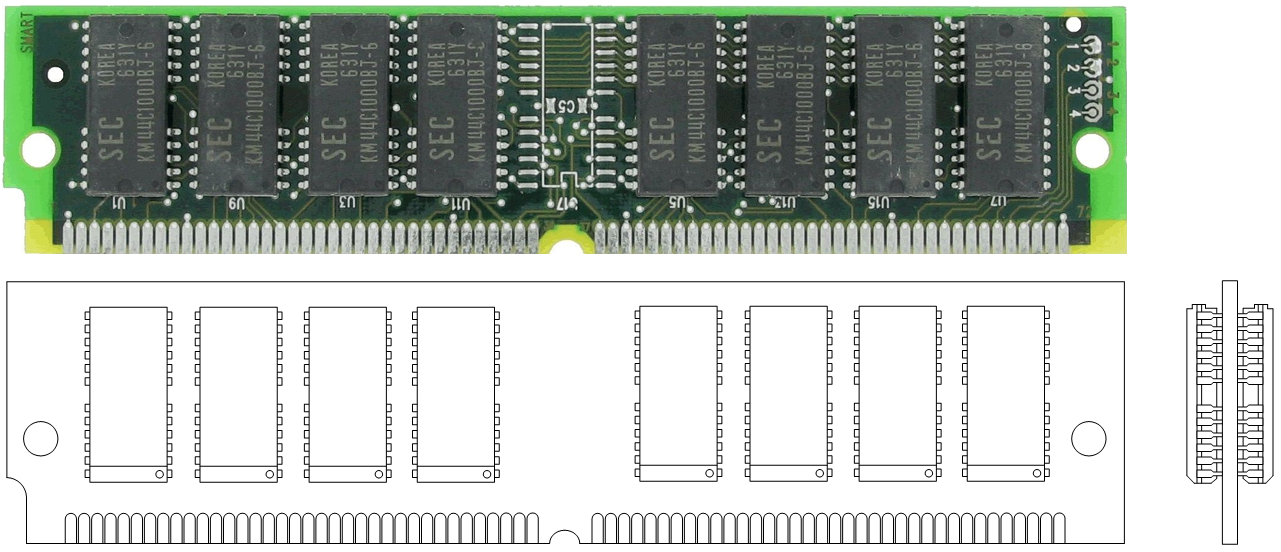
Being an indie author and one who loves producing technical illustrations, I take pride in the books that I authored. There are times when I would spend hours drafting a diagram for a topic in discussion, only to discard or shelve it when the content underwent changes during the process of proofreading. One example is the 72-pin SIMM below:

It would seem like a waste not to include it after all the hard work and time invested, but that's just me. Being a perfectionist, I expect nothing less than the best from myself and for my readers. I believe if a reader is willing to support me through honest purchase of my books, he or she should receive value for investing his or her hard-earned money on my works.

Of course, not everyone share this sentiment or conviction. Some have no qualms stealing free copies from authors who make conscientious efforts to share their knowledge. Others go even further to rip-off the small earnings of these authors who spent months to a year writing their books, by offering pirated copies online in return for a fraction of the book price. It cost these pirates nothing (except their dignity and integrity) but it results in loss of income for the authors and ultimately the engineering communities, because without a sustainable income they had to quit writing and whatever valuable insights and experience will not get passed on.

There is no real winner in the long haul. Just some temporary gains for the unscrupulous loafers who live off the hard works of authors. So think about it before you mindlessly download the next free copy of ebook from those dark webs.

Thursday, November 11, 2021

What Goes Up Must Come Down

That's as far as gravity is concerned, though there are those who argue it is the density of an object and not the gravitational force of the earth that is at work. I'm not a physicist but an engineer, so I'll just focus on what I know best——pull-up and pull-down resistors.

When you think about it, digital circuits aren't that 'digital' to begin with once you peel off the facade that confined their operational limits to the binary universe. Since its inception until today, the term 'digital' is not just about TTL or CMOS anymore. The insatiable appetite for the never ending quest of higher operating speeds has resulted in a kind of 'digital' metaverse, one in which different operating voltages exist side-by-side and interacting with each other via translators in the form of digital 'stargates'.

If ever MCU Studio decides to come out with a new series (X-Men and Avengers are really showing their age), perhaps they might want to consider Meta-Warriors or something to that effect. Just a suggestion.

Tuesday, November 2, 2021

Which Hierarchy?

Certainly not Maslow's 'hierarchy of needs'. When it comes to schematic diagrams, the term hierarchy means more than just a top-down structure:

Depending on the circuit design, a simple or complex hierarchy may be implemented to bring out the best representation possible. Still, it takes practice and experience to manage this kind of structure. Thankfully, most of us don't have to produce such designs. Deciphering them is another matter altogether.


Saturday, October 30, 2021

Your Preference Reveal Your Personality

Ever been asked which type of personality you belong to? Are you the rational (left-brain) or emotional (right-brain), the engineering or artistic type? When it comes to deciding what kind of component symbols to use in schematic diagram, it seems we're faced with the same dilemma.

Not to worry though. I'm sure you already know your preference when it comes to reading or drawing electronic circuits. But in case you're still undecided, this forthcoming book will give you a better idea of your engineering inclinations.

There is really no right or wrong, good or bad when it comes to choosing symbols, ANSI or IEEE. After all, deciphering schematics won't be fun without all the flavors and quirks out there, isn't it?

Have a good weekend and try not to lose sleep over it. (grin!)

Wednesday, October 27, 2021

Anatomy of a Writer's Dream

For those familiar with the concept of a schematic diagram, there is no need to elaborate further what constitute the elements that made up an electrical or electronic circuit. But for those who want a formal understanding on the anatomy, this is the book to anticipate.

I can't promise you how soon this book will hit the shelve, though. The year end is a busy period for me with much commitments to attend to. Hopefully, I can squeeze out some time to craft a few more pages. As of now, it is about 20% complete.

Like I said before, I take my work very seriously to give my readers an enjoyable reading experience. That means putting the extra effort and time into creating illustrations using Microsoft Visio to give an overall consistency and appeal. It is hard work, so I appreciate those who get my books through honest purchase and leave encouraging comments on Amazon to spur me on.

Next year will be the seventh year into my writing career. It will also be a make or break watershed year for me. My wife and I have been in discussion several times over, whether this move I made six years ago has been worth it, and whether it will be sustainable in the long run. All I can say is the royalties I earned is meagre and heavily supplemented by my wife's income as an admin staff. She is willing to support my dream and passion as an author, and believes in leaving a legacy that will benefit aspiring engineers in the future. For that, I am indebted and grateful to her.

I believe also in giving back to society which is why I continue to contribute a part of my book earnings to charities. It gives my writing a sense of mission and fulfillment, though at the back of my mind, I wish I could afford my wife who stick with me during this trying period a better quality of life. For now, she is content with the simple status as an author's wife. Perhaps next year when I complete my sixth engineering book, I may call it a day and do something else that will provide a steady income and give her a brighter future to look forward to.

So, yeah. I will probably look back with fondness that I've lived my dream for a while, albeit with a tint of sadness that it did not turn out the way I've hoped. Nonetheless, part of my engineering legacy will definitely live on in print. It should be consolation enough for the seven years I will have invested.

Tuesday, October 19, 2021

Heatsink for M.2 SSD

It is common knowledge that M.2 NVMe SSDs are prone to overheating which can lead to thermal throttling and result in performance degradation. Installing a heatsink brings improvement in temperature and even more so with sufficient air flow. So, I decided on a passive aluminum type 2280 form factor with  top and bottom thermal pads for better heat dissipation.

The red color finish adds a nice touch to the otherwise black and formidable appearance of the ASRock motherboard. Installation was quick and simple, and it cost me only three bucks. Hopefully, this new PC will last as long as my old faithful.

Now back to my writing.

Friday, October 15, 2021

New Desktop

Finally, after 13 years of service and a few interim upgrades, it's time to replace my old faithful E8400 core 2 dual desktop which is showing signs of aging. This time, instead of assembling from scratch, I decided to just order from an online shopping platform. After some comparisons and reading the reviews, this is my choice:

It is an AMD Ryzen 3 3200G CPU running on an ASRock A320M-HDV R4.0 motherboard with 8GB of DDR4 3200MHz memory, housed in a Tecware Nova M mini ATX tower casing with three fans. It came with a 250GB SSD and Windows 10 pre-installed. Price: Sgd 582.

Since the motherboard has a M.2 interface, I was tempted to add an NVMe SSD to give me the extra bit of data storage. Price: Sgd 50.

All in all, I spent a total of Sgd 632 (about 2 months of what I earned from my books) which is quite a good deal. The new PC is fast and incredibly quiet unlike the sound of CPU fan from the old PC which can be annoying at times. Best of all, it has TPM 2.0 which supports Windows 11, though I will not be upgrading to the new OS anytime soon until Microsoft fixes all the bugs and release a stable edition.

Wednesday, October 13, 2021

The Many Faces of Circuit Diagrams

I'm not sure how things were when you started learning to read circuit diagrams. As far as I'm concerned, I only learned about the term 'schematic' much latter when I fiddled with EDA tools in the early days of my employment. So in reality, I always refer to electrical drawings as circuit diagrams. Of course, many electronic engineers begin their journey as a hobbyist building simple to sophisticated projects, usually from kits sold in electronics shops, to those found in electronics magazines.

I had my fair shares of fun and frustrations in building those electronic kits and projects. But it was through all the hard knocks that I learned how to decipher circuit diagrams. You might not believe or even seen one of these symbol templates that engineers used to draw circuits before the advent of EDA software.

I do miss the good old days but given a choice, I'd rather not go back to drawing circuits by hand. Electronics engineers never have it so good in this twenty-first century.