To My Readers


If this is the first time you're visiting my blog, thank you. Whether you're interested or just curious to find out about PCB reverse engineering (PCB-RE), I hope you'll find something useful here.

This blog contains many snippets of the content in my books to provide a more detailed overall sampling for my would-be readers to be better informed before making the purchase. Of course, the book contains more photos and nice illustrations, as evidence from its cover page. Hopefully, this online trailer version will whet your appetite enough to want to get a copy for yourself.

Top Review

I started doing component level repair of electronics with (and without) schematics more than 40 years ago, which activity often involves reverse-engineering of printed circuit boards. Although over the years my technical interests have shifted into particle beam instrumentation, electron microscopy, and focused ion beam technology fields, till this day——and more often than not——PCB repairs have returned multiple multi-million-dollar accelerators, FIB, and SEM instruments back to operation, delivering great satisfaction and some profit.

Many of the methods described by Keng Tiong in great details are similar to the approaches I've developed, but some of the techniques are different, and as effective and useful as efficient and practical. Systematic approach and collection of useful information presented in his books are not only invaluable for a novice approaching PCB-level reverse engineering, but also very interesting reading and hands-on reference for professionals.

Focus on reverse engineering instead of original design provides unique perspective into workings of electronics, and in my opinion books by Keng Tiong (I've got all three of them) are must-read for anybody trying to develop good understanding of electronics——together with writings by Paul Horowitz and Winfield Hill, Phil Hobbs, Jim Williams, Bob Pease, Howard Johnson and Martin Graham, Sam Goldwasser, and other world's top electronics experts.

Valery Ray
Particle Beam Systems Technologist

Wednesday, April 1, 2020

V.Ray Follow-Up Email

After making the LinkedIn connection with this reader by the name Valery Ray and reminding him to collect the book freebies and review bonus from me, here's his email reply:
Thank you for connection and for offering to share additional materials available for the first book. 
I've started doing component level repair of electronics with (and without) schematics more then 40 years ago. Although since that time my technical interests have moved onto particle beam instrumentation and FIB technology, once in a while PCB repair returns to operation multi-million-dollar FIB/SEM instrument, bringing great satisfaction and some profit. 
Interestingly enough many of the methods you describing are similar to the approaches I've developed, but some of the techniques you describe are different, and as effective and useful as they are practical. Systematic approach presented in your books and collection of useful information is not only invaluable for a novice approaching PCB-level reverse engineering, but also very interesting reading and collection of reference material for professionals.
Well, you heard it from a field-weathered engineer with over 40 years of experience in PCB-RE. So if you're still wondering whether to go into this niche but satisfying endeavor in your engineering career, why not get yourself a copy to acquire the coveted knowledge and shorten your learning curve?

20020

Today, the total pageviews for my blog has crossed the 20,000 mark!


Readership from different countries now stand at 110. Thank you for visiting and recommending this blog. It would not have been possible without your help!

With the current stay and work from home advisory due to the CoVid-19 situation, please continue to share the posts with those whom you think might find useful and beneficial for their engineering endeavors.

Better yet, get my books to help you occupy your time and equip yourself during this probative period, and be ready when the restriction is lifted and the economy restarted.

Meantime, take care and stay safe, everyone!

Tuesday, March 31, 2020

LinkedIn Review

Have not login to my LinkedIn account for quite sometime, so it was a pleasant surprise to find a text message from a reader who bought my three books:


Here's his review and my reply:


Curious as to his profession, I went to his page and this is what he described about himself:
I'm a consultant - I solve problems you can't get solved by anybody else, for any money in ways your engineering department have declared heretical.
Now that's one heck of a confident guy indeed!


Tuesday, March 24, 2020

Coronavirus (CoVid-19)

Since December last year, a pneumonia-like symptom was detected among flu patients in the Wuhan city of Hebei province in China. City officials initially dismissed it and even attempted to suppress any alert that might cause alarm to the Central Communist Party (CCP) in Beijing. But before long, this virus started to spread quickly among the city residents and spiral out of control as those infected transit in and out of the city to other parts of the mainland.

Soon, other Asia countries also felt the impact of this unknown but highly-contagious virus. As a precautionary measure, flights to and from China were cancelled while citizens working abroad were quickly brought home through chartered flights and given 14-days stay-home orders. Cruise liners were denied docking when the British-registered cruise ship Diamond Princess was found to carry infected passengers. All this while, China's infection statistics literally exploded in the epicenter as the city of Wuhan was put into lockdown mode.

Singapore was not spared either, considering there are many Chinese nationals who have obtained citizenship and permanent resident status, and these have went back to their former homeland to celebrate the Lunar New Year with their families and friends. The same quarantine measures were also enforced on them upon their return from the festive holiday. Thankfully, the government had learned well from the 2004 SARS saga and the National Center for Infectious Diseases (NCID) quickly implemented various measures to contain the spread.


The World Health Organization (WHO) closely monitored the situation and development in Asia and in particularly China, refusing to announce it as a pandemic since that would most certainly cause worldwide panic and impact the global economy. To remove the stigma of associating the virus to China by its initial name Wuhan-virus, WHO codenamed it the CoVid-19 virus, a new strain of the coronavirus that is especially lethal to the elderly and those with underlying health or medical issues. The west, however, seemed oblivious to this growing threat and went on its daily routines as usual.

Before long, Italy reported its first cases of infection and within just weeks, the number spiraled as its medical facilities buckled under the weight of thousands of patients needing healthcare. To date, its fatality rate has overtaken China and South Korea as many succumbed to the virus. Two important reasons could be attributed: 1. Italy has the second highest number of elderly in the world, next to Japan; and 2. Its culture of exchanging kisses and cheek rubs most likely accelerated the infection process. But the virus is not done yet. Other European countries such as UK, France, Germany and Spain became the latest victims of CoVid-19's ravages.

It was only a matter of time before the United States felt its sting. As of now, New York has become the epicenter in US, with other states like Florida, Illinois and Michigan taking a hard hit. Predictably, Wall Streets went from its long-run Bull market straight into the Bear bucket. Billions worth of stock investment were wiped out overnight as companies and businesses struggle to stay afloat from the international trade and supply chain freeze. Unemployment and business stagnation forced many to look to the government for financial aid and bailout.

Indeed, the future looks bleak and dark for the whole world as WHO finally declared the CoVid-19 a worldwide pandemic. The only thing we can do now is wait and pray that with the coming of summer, there will be some relief and a possible cure soon for this scourge...

Thursday, February 27, 2020

From Italy with Thanks!

A few days ago, I received the following email from a reader by the name Leandro Genovese who purchased my trilogy books:
I discovered only now that there are some other useful resources over the special books you wrote! I would like to receive this freebies and the bonuses, but yes, I'll attach in this email the proof of purchase. I want to add a special thanks for the help your material gave to me. It's very useful for a newbie like me and I'm very grateful.
Thanks Thanks Thanks!!! 
Here's the proof of purchase he attached (a photo of the three PCB-RE books):


From his name and the foreign text in the email header, I gathered that he is from Italy. It's always nice to know that my works are greatly appreciated by readers around the world, especially those who are new and starting out on this exciting journey of PCB-RE.

I wish him all the best and thank him for the support through honest purchase, which is important for a full-time author like me.

As they would say in Italian: Grazie mille!

Thursday, February 13, 2020

A Reader's Bookshelf

Had been absent from Twitter for quite a while, so it came as a plesent surprise when I was browsing through the latest posts that I came across someone putting up a picture of his bookshelf in the works. Right in the middle shelf are two of my books! Can you see them?


This young engineer by the name of Jeremy Hong is no stranger to me. He bought all my books on PCB-RE and left glowing reviews for the first two. Not only that, he conducted talks on this niche subject at various hackers convention and meet-ups, and recommended my sequel book PCB-RE: Tools & Techniques in his presentations.

This was what he said about my books in an email:
So far I am really enjoying the books, they have been super informative and in some cases kind of mind-blowing, but I'm finally glad that I now have reference books dedicated to this subject.
You can google and find him with the search words 'Hong Electronics'.

Sunday, January 19, 2020

Occasional Bulk Orders

Among the trilogy of my PCB reverse engineering books, the sequel PCB-RE: Tools & Techniques is the most popular, with the first book The Art of PCB-RE coming in a close second. Sales of these books are quite constant across each month but occasionally there would be a bulk order made, which I suspect were procurement by a company instead of an individual.

Why would I say that? Well, individuals don't just buy 10 or 20 books at one go unless they want to give the books away as Christmas gifts to their friends, and we're talking a big group of friends who have interest in this niche topic. On a company level, however, there are some good reasons to do so:

1. It's core business is providing PCB-RE training to customers and since my books are currently the only available resources on this subject, they are used as a kind of reference textbooks for the training program.

2. It is engaged in PCB-RE products or services and one of the best corporate gifts is books related to their nature of business. It's a kind of reward for loyalty to the company or appreciation for long-term customers.

3. It is advantageous to use the books as attraction at exhibition booths to potential customers looking for a solution to their obsolescence problem, or who are thinking of buying PCB-RE product software or else engaging such services.

The above three points are real-life examples from companies who have ordered from me personally at special rates, instead of ordering online at the retail pricing. But whatever the reasons, I'm grateful for these companies who supported me in honest purchase of my books, and I wish them well in their businesses and future ventures.

Thursday, January 9, 2020

Circuit Topologies

Next to identifying and deciphering components, familiarity with electronic circuit topologies that are common to different PCB types may prove crucial between a prematurely aborted and a successful PCB-RE attempt. The term 'topology' used here is not referring to network theory in the strictest sense that is taught in the classroom; rather, it refers to the 'configuration' or 'model' of a circuit, as in an op-amp configuration or a filter model.

In this respect, any circuit——digital or analog——is made up of a collection of discrete and/or integrated components that conforms to a certain pattern of connectivity to perform a known function. For example, consider the various passive filter topologies made up of LC discrete components:


Depending on the positions and values of the inductors and capacitors, these can form lowpass, high-pass or bandpass filters of either balanced or unbalanced configurations, as shown below:


Then, of course, there are the active filter topologies made up of op-amps and RC discrete components:


This is just a small sample of what circuit topologies is about. There are many types in analog, digital and power circuits across the spectrum of electronics and PCB designs, too numerous to include here. However, there is no reason to despair or become discourage, since these resources can be readily found online in electronics educational sites and discussion forums. Articles and videos are also helpful sources of information or tutorials to increase your knowledge and understanding of how circuits are designed and work.

Monday, December 23, 2019

Seasons Greetings!

Christmas is just round the corner following the winter solstice. It's the time of the year to gather with people you love and care about, to spend quality time and enjoy their company over heart-warming meals and moments.

It's also a time to reflect and reminiscent, and then look forward to a new year, hopeful of a better and brighter future. And while we're at it, let's not forget to go something good to help the less fortunate, be it charity or community volunteering work. For readers who have bought my books, I would like to thank you for your honest purchase, and to let you know that part of the royalties goes to support the National Kidney Foundation (NKF), so you're actually contributing to charity as well.

Here's wishing all my readers:


Stay safe and well through the season holidays!

Saturday, December 14, 2019

Packaging Challenges

You might be surprised to know that electronics packaging predates the printed circuit board. Over the past 60 years, packages have continued to shrink in footprints yet increase in functionalities. Some packages are no bigger than the period at the end of this sentence.Today, there are more types of packages than ever before that can be found mounted on a given PCB. The ever expanding package acroniums is proof of this phenomenon: QFN, QFP, SOT, TSSOP, PDIP, WLCSP, BGA, FPBGA, SOIC, PoP, COF, WLP, FOWLP, and many more.

COF and WLP Packaging

This increasing trend in PCB design also presents challenges to PCB reverse engineering, especially for newbies and occasional apprentices. Identifying these components is one thing; finding related information and datasheets is another; yet still to overcome is the accessibility of probe points since most of these use BGA footprints with high-density pin-counts to reduce PCB real estate. It's a literal nightmare for manual PCB-RE work.

So unless you have the resources to do it, my advice is to steer clear of them unless it's a do-or-die mission. Remember, you have been warned.

Friday, December 6, 2019

Deciphering Components

Except for ICs and components with large surface areas which permit printing of part numbers most surface mount devices use some form of cryptic coding system to indicate their identities or values. Some basic components like resistors, resistor networks, and capacitors may also contain long strings of alphanumeric characters that require their manufacturers' references to make sense of their package and content. Take for example the two types of through-hole resistor coding:


The pair on the left uses color coding, with four and five bands of color for the top and bottom resistors, respectively. The pair on the right shows the same value in alphanumeric notation wrapped around the resistor's body. Resistor color and numerical codes are necessary for deciphering both color and alphanumeric codes found on resistors and capacitors.

Surface-mounted devices, passive and active, are becoming common place these days so it's good to keep a copy of SMD codebook at hand for easy reference and be familiar with their outlines and packaging.

Exercise: Can you identify and decipher the components on a PCB shown below?


According to their layout:

Chip Capacitor, Tantalum                                                  Chip Resistor, size 0603
1uF 35V                                                                             10 Ohms

Diode, case SOD-80               Low-Capacitance               NPN Transistor, SOT-323
Switching                                Diode Array (5V)                 BFR92AW

Chip Resistor, size 0805
4.64K                                                                                 Chip Capacitor, unknown

Chip Capacitor, unknown

How many did you manage to get right?


Ps: If you have purchased The Art of PCB Reverse Engineering, you are entitled to get a copy of the SMD Code Reference Book (500+ pages) and other goodies.

Sunday, December 1, 2019

An Identity Crisis

If there is any certainty when doing PCB-RE, it is encountering 'unknowns'——components that are custom-built, without readily available information or datasheets. The proliferation of mobile devices and gadgets has seen ICs with multiple specialized functions integrated into a small wafer die,26 in a bid to reduce physical size and power consumption.

Take, for example, Apple's iPhone 5S motherboard shown below:


It's hard to imagine that so many components could be cramped within that 4.5-by-0.85 inch of physical space on both sides of the PCB, most of the chips being BGA-type and some with high pin-count footprints! This should come as no surprise, given that advances in wafer fabrication technology has already achieved under the sub 20-micron scale presently.

But don't be intimidated or become discouraged by this revelation. PCBs of this sort are an exception rather than the norm for manual PCB-RE. Truth is, it's not cost-effective to reverse engineer such boards in the first place, considering the low cost of manufacturing that arises from the high-volume production demands for these devices. It simply doesn't make economic sense.

That said, even in moderately complex through-hole or surface-mounted boards, do anticipate finding some unknown components as well. Sometimes it's not the big chips that stump you (though that is quite likely to happen) but the little discrete parts that seemingly look harmless enough until you try to identify them. Here's one example to prove my point: a reader once emailed me the following photos seeking my assistance to identify them:


Can you guess what these are? On first look, you may mistake them to be some sort of SMD resistors, except that the unique numbering and 3-terminal pinout provide tell-tale signs they are something else. Want to know what they are? Get a copy of PCB-RE: Real-World Examples and you'll learn their identity and many other useful tips.


Thursday, November 28, 2019

Evaluating Your Chances

What are the chances of success in doing PCB-RE? It depends on several factors and your approach. Within each approach, the time and effort required will also increase with the complexity of the PCB, while the rate of success and the quality produced will be affected by the capability of the equipment or tool used, as well as the experience of the engineer doing the PCB-RE work. Quantifying the methods and their related factors into a single chart offers a rough but straightforward comparison as shown in the table below:


Another way of representation would be individual SWOT charts that give a sweeping view of each approach's strengths and weaknesses. The closer to the center (i.e. bullseye) a factor is, the better the weightage and vice versa.


No matter what you opt for, it is important that you have a good understanding of the process involved, not just the cost incurred. Other more specialized aspects of PCB-RE such as mobile forensics may require formal training to be proficient in performing the tasks yourself, unless you prefer to engage a professional to do the job. These exotic, CSI-like practices and many other PCB-RE methods are also covered in my best-selling book PCB-RE: Tools & Techniques.

Saturday, November 23, 2019

Old but not Obsolete

Good things never die, even if they grow old. The same can be said about software, one in particular which I've fondly remembered since my early engineering days...

You might not believe me if I tell you that there's a community of PCB designers who're die-hard DOSbased OrCAD fans. For readers who've worked with the DOS version of OrCAD products, it may come as a pleasant surprise that these EDA tools, which used to cost from between $495-$1,995 individually or $3,995 for a complete suite, are now available for download complete with user and reference manuals. You'll need to register as a member first—subject to approval by the moderators of the group, though.

OrCAD ESP
OrCAD SDT
OrCAD VST
OrCAD PCB

The last DOS version is the OrCAD ESP 4.40 release which comprises the following modules:
  • SDT 386+ 1.21 Schematic Design Tool
  • VST 386+ 1.20 Verification & Simulation Tool
  • PCB 386+ 2.22 PCB Layout Tool
  • PLD 386+ 2.01 Programmable Logic Design Tool
  • MOD 386+ 4.04 PLD Modeling Tool

I've worked extensively with the SDT 3.21 in my early engineering days from 1990-1995, mainly to draft schematics as well as flowcharts and 2D mechanical drawings for my test program set documents. To the hardware engineers in my company's engineering design department, this humble piece of software was just a toy compared to their powerhouse EDA suite from Mentor Graphics running on Sun's top-end graphical workstations. Perhaps, but then again there are many products out in the market which were designed and produced using OrCAD too.

So how do we run these legacy DOS software from within modern operating systems that are now the dominant landscape of most PCs today? The answer: Virtual PC or DOS emulator. And there are many flavors to choose from—Microsoft's Virtual PC, Oracle VM's VirtualBox, VMware Player, the open source DOSBox, etc. Most of these x86 machine emulators are free and they support and run different OSes such as Linux, Windows, OS/2, BeOS, and even the Mac OS X.220 I've installed and run Microsoft's Virtual PC and DOSBox with some of my favorite software of by-gone era just to re-live the good old nostalgic DOS days.

For more details and links to these resources, get a copy of The Art of PCB Reverse Engineering. The full-color and standard editions are similar in content, except the color edition costs slightly higher but hey, you get to see the illustrations and photos in their full glory!

Monday, November 18, 2019

X-Men Reverse Apocalypse

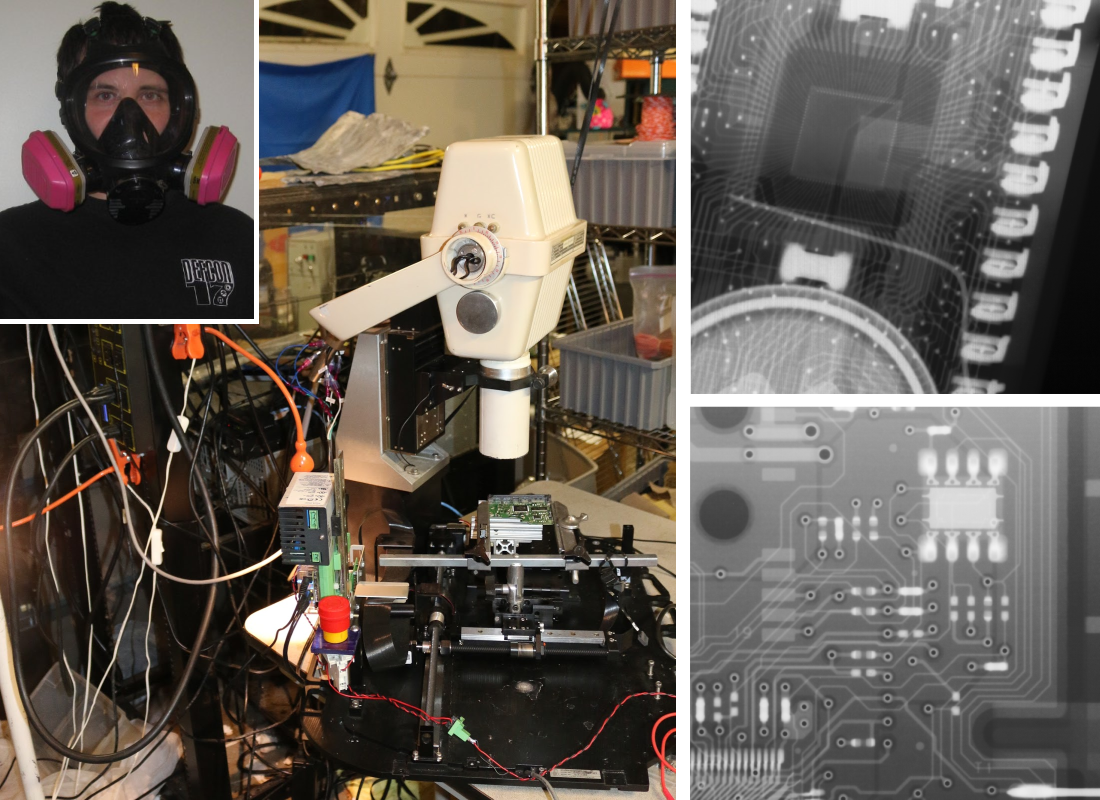
One of the best things about writing the sequel book PCB-RE:Tools & Techniques was having the opportunity to know and interact with nice and interesting people. John McMaster was one of them. I got to know him while searching for X-ray related PCB-RE information, and came upon his Twitter page on a home-brew X-ray machine which he designed and built for his IC reverse engineering work. In fact, his amazing tool was featured in a number of websites like Makezine and Dangerous Prototypes.

John was kind enough to give permission for me to include this project in my book, and he even provided me with the necessary X-ray prints of his endeavors, as well as his fun bio photo:


Of course, I was more interested in the PCB-RE aspect than the IC-RE which is his main focus. Nonetheless, being the helpful guy that he is, my requests were granted:


John went so far as to fill me in with the details of his home-brewed project through our email correspondences, which readers who bought the book would have the pleasure of learning firsthand from the 'master', Mcmaster himself. (pun intended)

So if you have not gotten a copy yet, you may want to get it here.

Tuesday, November 5, 2019

Manual PCB-RE: Instrumentation

Setting up an electronic lab like a commercial repair house is certainly out of the question,unless you're prepared to fork out a fortune to do so. But if you're thinking of doing PCB-RE manually, all you really need are just a couple of basic inexpensive equipment:
  • Digital Multimeter (DMM)
  • SMD LCR Meter
  • Power Supply
  • Universal Device Programmer
  • Multi-Protocol Adapter

Most engineers should be well acquainted with the first three; the last two are not really for novice but can come in handy if you want to delve deeper and get a better understanding into the workings of a board.

Digital Multimeter (DMM)

The DMM is perhaps the most basic measuring instrument an engineer or technician will ever get to learn and use at work. Increasingly, digital multimeters are preferred over analog ones for their accuracy, functions and ease of operation, since they come with a numerical display that provides quick reading of the electrical entities being measured.

Choosing a DMM would seem like a no brainer but there are subtle yet important differences that separate a good model from an average one. Besides quality and reliability, resolution and accuracy are two primary factors that should not be overlooked. Though we're not particularly concerned with these traits when it comes to doing PCB-RE, it is imperative to get a DMM that has fast continuity test response.

This feature becomes apparent when you need to do a sweep on rows of connector pins to get a connectivity detection beep, so a slow response will potentially miss probe points that have valid connections. So invest in a good DMM to save yourself from this stigma.

SMD LCR Meter

Surface-mounted components are becoming popular with board designers due to the small sizes and space economy they afford. Some of these devices are so miniature there is hardly space for part numbers or even abbreviated values to be printed on them. Using the probes of a DMM to measure these devices can be challenging and frustrating. Enter the SMD LCR meter.


This remarkable and portable one-hand operated instrument identifies both marked and unmarked SMD-components with easy probing, passive or through-hole. A standard model can measure capacitance, inductance and resistance with speed and precision. Advance model can even check secondary parameters such as the capacitor's ESR, quality factor (Q),
dissipation factor (D) and impedance (Z).

SMD LCR meters come in different makes and functions. Those providing only basic functions may cost just between $20-$50 apiece, whereas more advanced models can run into $150-$300 an unit.

Power Supply

You have two choices when it comes to power supply: fixed and adjustable. Depending on what you intend to use with the power sources, you can opt for:
  • Fixed power supplies with common voltages such as +5V, +12V, +3.3V, etc. which many PCBs require. A PC power supply unit will be adequate to provide these multiple outputs. But a note of caution: you will need to provide some kind of safety measures to ensure you don't fry the PCBs you're working on.
  • Adjustable power supplies. These benchtop equipment are more costly but still affordable, and they provide built-in current limiting and over-voltage protections, plus you get to have a variable range of voltages at your disposal.

Thursday, October 31, 2019

Manual PCB-RE: Hand and Power Tools

These days, a set of assortment hand and power toolkit can be had for between $100-$200, one would think it makes no sense to buy each item separately. While there is no harm getting one of these kits if you have the extra cash to spare, you may want to be more selective in the quality and suitability of the tools you are going to personalize and use for all your future PCB-RE works without over-cluttering your work space and spending time searching for them.

As a minimum, I would recommend the following:


The wire stripper may seem like an odd addition to the manual tool set, but it does have a role to play in the PCB-RE process when required.

Two other hand tools I can think of that's good to add to the above list are a set of fine grain hand files and a small hammer or mallet. The hand files come in handy when you need to scrap off stubborn lacquer conformal coating from the tip of component pins to facilitate contact probing during continuity check. The hammer or mallet is used in conjunction with the flat-head screwdriver to loosen screws with tops that are rounded out.

One last versatile tool is the power drill set. The motorized drill can either be battery powered or cabled. Different sets of drill bits, screwdriver bits and nut drivers permit drilling or screw and bolt locking and loosening with ease.

Tuesday, October 22, 2019

Manual PCB-RE: Equipment & Tools

Every trade has its expert, and every master craftsman has his tools. PCB-RE engineers are no exception, more so when it comes to doing PCB-RE manually. In my fifteen years of experience reverse engineering printed circuit boards (PCB) and modular electronic units, I've come to appreciate the importance of having a good set of tools on hand to get the job done. Not just the basic toolkit, but the essential ones.

A typical electronics workbench setup (courtesy of Mitch Haile)

If you want to do serious manual PCB-RE, whether in a workshop setting of your employment or in the comfort of your own workspace at home, some form of electronic equipment and hand tools are indispensable. Depending on how comprehensive a level of PCB-RE you intend to engage in, it will determine the outcome of your inventory and acquisition. Generally, there are four categories to consider:

 1. Hand and power tools
 2. Instrumentation
 3. PCB-related equipment
 4. Diagramming tool

The first three are hardware and safety related while the fourth is software, though strictly speaking, the line of distinction is not that concise in some cases.

Sunday, August 18, 2019

The Magic Bullet

Some while ago, I came across a query in Reddit regarding my books:
There are a few books on Amazon authored by Mr. Keng Tiong Ng that cover the topic of reverse engineering PCBs. Anyone in the know find them useful? 
Here's one reply:
They're an enjoyable read, but nothing exactly earth-shattering...
Well, any hacker—hardware or software—would tell you in the face, there's no shortcut to doing reverse engineering. Those in the engineering industry know that the work of an engineer is never easy, right from the start when you take up this field of study to the day you learn and master the trade and become good at what you do. Temple Grandin puts it succinctly when he said:
People are always looking for the single magic bullet that will totally change everything. There is no single magic bullet.
PCB-RE is no exception. In my 15 years of reversing PCBs and electronic modules as part of doing repair and diagnosis of circuit boards, I had to literally 'bite the bullet' and refused to call it quit if ever the schematic diagrams were to materialize in the end. Of course, knowing the techniques of doing PCB-RE and the kind of tools available to ease the process will be a great help to reduce the learning curve and become proficient quickly. Which is why one reader, a 65-year old retired engineer, commented:
Books on this topic are as rare as hens teeth.The first book The Art of PCB Reverse Engineering was mainly about RE techniques and ways to keep the extracted data organized. It was really well written and an enjoyable read. The sequel PCB-RE book is about the tools (hardware and software) that can be made or purchased to ease the RE process. Again it was really well written and a good read. I've been doing RE for years mainly to help in the repair undocumented products and yet I still found some very useful stuff in these two books. The reader should be aware that RE takes a lot of time and no book is going to be a magic bullet that will give instant results. However learning to be organized and to correctly document the results can be learned from these books and that means you get to waste less time. You can also reuse and expand a well documented partial RE when tackling a different fault on the same product. Have no fear of Mr Ng's English; it is really good.
That said, there IS only one 'magic bullet' but do you have the courage to bite it? Here it is...


One thing the person who replied is right though—my books are an enjoyable read. And if I may add, they're also informative and worth your time and money for all the heart and sweat I put into writing them, including the contributions of fellow engineers who shared their expertise and valuable experiences.

Wednesday, July 31, 2019

Getting Started with PCB-RE

If you're like me, most likely you're self-taught in the PCB-RE skillset out of necessity. Maybe you've developed your own methodology and even have the luxury of automated equipment to help cut down the time and effort in doing those menial tasks of connectivity probing. Well, good for you!

For the majority of PCB-RE engineers, however, it is the manual route using the digital multimeter (DMM). Whether you've come out with a streamlined process of doing it, that varies from one person to another and also the kind of resources and drafting tools you use. 

What about budding enthusiasts who've never done it before and decided to give it a try? Or perhaps some had already done so but quit halfway due to lack of know-how. Until four years ago, the only way to get a good peek of this coveted art was via online articles and postings by engineers who've 'been there, done that' and were kind enough to share their experiences and advice. But these gems are usually scattered and at best bits and pieces that require much time to search and sift out from the tons of jumbled information.

The good news is, there is currently three books published that allow a beginner to be properly introduced to this niche topic, namely, The Art of PCB Reverse Engineering, PCB-RE: Tools & Techniques, and PCB-RE: Real World Examples. So which book should you read first? This post will hopefully answer that question and point you in the right direction.

The Art of PCB Reverse Engineering covers the basics of doing manual PCB-RE and employs Microsoft Visio as the tool of choice for drafting schematic diagrams. It has six chapters and five appendices that guides the reader through a systematic process of doing preparation work in analyzing the PCB for accessibility, creating a bill of materials, determining the type of conformal coating to be removed, if present, and extracting the right information from datasheets.

A large part of the book goes into the details of helping the reader develop good schematic drawing habits for consistency of style and good readability. A real-world example using a SCSI host adapter card is provided with a step-by-step guide. For those familiar with Microsoft Visio, there is even a chapter on advanced techniques that will further sharpen your skill with this versatile drafting tool.

The appendices contain many useful references and charts that will cut down time and effort in looking up for the needed information while engaging in PCB-RE work.There are also freebies such as Visio templates and drawings, SMD and IC Master references, IC packaging and dimensions, etc to get you up to speed. Additional bonuses are also available for readers who leave a positive review on Amazon.

Click on the photo to order on Amazon.


PCB-RE: Tools & Techniques is a sequel book which showcases the works of several renown industrial experts such as Joe Grand (aka Kingpin), Bill Loving and Jeff Rupert of ScanCAD International, Bob Elder of TEEL Technologies, and Dr Sergei Skorobogatov of Cambridge University, etc.

This book is aimed at readers who want to have a better overall understanding of the equipment and methodologies used in the PCB-RE industry. Both automated and semi-automated processes are discussed, from the amazing flying probe tester (FPT) to the compact Clip-N-Learn benchtop workstation, from brute force deconstruction techniques to the elusive X-ray de-layering, and from board-level boundary scan to the microscopic chip-level and chip-off forensic. You name it, the book has it!

Besides the usual useful appendices, there is a separate section on PCB-RE resources that you can either buy or build on your own, as well as a rich list of freeware and online resources which you can refer to build up your own library of knowledge and know-how.

If you're not ready to take on the PCB-RE challenge just yet, perhaps this is the place to start your journey and get a peek into the fascinating world of hardware reverse engineering.

Click on the photo to order on Amazon.


PCB-R: Real-World Examples is the trilogy to the PCB-RE collection and like the sequel book, it also has several contributing authors who shared their invaluable insights and experiences. What better way to learn PCB-RE than to learn it from real-world engineers?

In this book, I show readers how the manual PCB-RE approach is done with a complex board, detailing the steps to divide-and-conquer a hybrid PCB. You will see first hand the process and methodology that I developed and used in my 15 years of reverse engineering work.

Readers will also be treated to some behind-the-scene information used by one of the most successful PCB-RE service providers, ENA Electronics Inc., in their industry practices and processes. Game for a round of firmware hacking? Then let our hacker specialist, Juan Carlos, take you for a spin inside a Huawei wireless router! And if that does not whet your PCB-RE appetite, how about X-ray on an Arduino UNO, breakdown on a quadcopter drone, and come face to face with the innards of a Rigol digital oscilloscope?

Of course, there's still the ever informative appendices, reviews on essential tools you can add to your PCB-RE arsenal, and additional case studies to pore over.

Click on the photo to order on Amazon.


Latest Update!

The fourth and final book on the PCB-RE subject is now available. It covers primarily on the Manual PCB-RE methodology and demonstrates how to reverse engineer a Gigabyte GeForce 8600GT graphics card. You can click on this link to go to the post for more details.


All my books are written in an engaging style to afford readers an enjoyable reading experience, complete with plenty of informative footnotes and humorous personal anecdotes. Need I say more?


Thursday, July 25, 2019

Personal Contemplation on My Writing Journey

Back in 2013 when I started out to write my first engineering book, The Art of PCB Reverse Engineering, while working part time, I had only one thing in mind—to document my own experience in this niche skillset which I've developed over the span of 15 years. After two years of grit and sweat, the book finally went online in all Amazon bookstores.

Little did I realize that it not only created a stir in the PCB-RE community because no one had ever attempted putting this much coveted topic into print, it launched me further into deep waters as readers prodded me on to give the PCB-RE subject a more thorough treatment. Of course, besides being delighted, I was painfully aware of my own inadequacy since my expertise lies mainly in the manual method, although I had limited exposure to semi-automated approach using the clip-and-learn equipment in my workplace, and explored with industrial equipment provider on the flying probe platform as a plausible alternative which, unfortunately did not materialize due to cost justification.

After few months of extensive research and intensive read-ups, I was convinced that if I were to have any success in writing a sequel book addressing other PCB-RE techniques, I would need the help of engineers with the relevant experience and knowledge. One of the first person I looked up was none other than Joe Grand aka 'Kingpin', the legendary hardware hacker of the Boston-based hacker group L0pht Heavy Industries who achieved mainstream popularity at the age of 33 after appearing on a Discovery Channel series Prototype This! In all honesty, I was just trying my luck but never in the world did I imagine that Joe not only responded to my email and request, but heartily endorsed the book in his own website! So two years after 'The Art' book was published, PCB-RE: Tools & Techniques was released with much anticipation, albeit without any fanfare. But it made big waves with the PCB-RE community, thanks to the many well-known contributors who supported my daring endeavor.

I would have easily called it a day after the dust settled over the initial excitement but somehow the nagging feeling that a third book—a trilogy, would be fitting to complete the PCB-RE reading experience, something of a practical nature to show those picking up this skillset how it's really done in the real-world. And so, PCB-RE: Real-World Examples came into being a year later.


With three PCB-RE books now available to any aspiring PCB-RE engineer wannabe, perhaps one question remains to be answered—which book should I start first? Well, I'll leave that to another post for now...


Friday, July 19, 2019

ScanCAD News Update

Readers who bought my sequel book, PCB-RE: Tools & Techniques, will be familiar with the ScanCAD product featured in one of the chapters, The Art of Perfect PCB-RE. The contributors, Bill Loving (CEO) and Jeff Rupert, presented many aspects of this niche skillset and weighted the pros and cons of the various industry practices. It's a comprehensive eye-opener for those beginning on this engineering endeavor and provides a concise summary for amateurs and professionals alike.

Recently, I was alerted to a new update on ScanCAD's core software release version 8.80 which spots a much improved interface that promises a far better user experience and workflow.


I believe the basic process involved using different tool or equipment with this software should still be similar, but with a more simple, intuitive and streamlined workspace as stated. Readers interested to find out more can visit their web page here.

Have a great weekend!

Tuesday, July 16, 2019

Fifth in Top 20

Blogger has this neat feature which informs me where the traffic to my blog comes from, though I seldom take note of it. Today, out of curiosity, I clicked on one of the links and discovered to my surprise that my blog came in fifth in the top 20 PCB blogs and websites in 2019:


Pretty cool, huh?

Saturday, July 13, 2019

100 Countries and Counting...

As of today, my blog has hit over 14,700 views with visitors from over 100 countries. Not surprising most are from the USA, and Singapore coming in second followed by France, UK and India. Based on sales of the trilogy books, again Amazon US comes in first, followed by UK and then the EU.


Without the help of readers with good engineering community spirit, this blog would not have achieved such success in less than two years. But I'm sure more can be done to get engineers interested in PCB-RE aware of these resources, if readers can help spread the word in forums and discussion groups.

If you have found my works to be beneficial, all I ask is that you recommend my books or this blog to your friends, colleagues or the engineering community which you belong. It would encourage me to blog more often and even write about my other engineering experience in PCB testing, automated test platforms, diagnostics skills, etc.

Thanks much!

Tuesday, July 2, 2019

Excerpts from the Trilogy

Below is a short quip from Chapter 3 of the trilogy:

The layout diagram for the control logic card is drawn with the help of Microsoft Visio, a versatile 2D technical drafting tool. The whole illustration may look rather complex but if you break it down, each component is really made up of a group of basic shapes (circle, line, rectangle, triangle, etc.) that can be arrayed or aligned easily with Visio's shape manipulation functions. In fact, you can use layering technique to place a photo of the control logic card on one layer and then superimpose the component layout symbols you created on top, taking reference from the photo for quick placement.


You'll notice that there are plenty of footnotes provided to give greater details and interesting notes or observations for an enriching read, without burdening the main text for those who just want a quick first-read-through experience, and then savoring the additional information later.

This feature is found in all my three books on the coveted subject on PCB Reverse Engineering (PCB-RE) which till date, is available only in printed form with treatment on its fundamentals, tools & techniques, and real-world examples, with contributions from various experienced industry experts.

Freebies are available for download to those who purchase 'The Art of PCB-RE' and bonuses are given out to readers who leave their reviews on Amazon. Get your copies today!