To My Readers


If this is the first time you're visiting my blog, thank you. Whether you're interested or just curious to find out about PCB reverse engineering (PCB-RE), I hope you'll find something useful here.

This blog contains many snippets of the content in my books to provide a more detailed overall sampling for my would-be readers to be better informed before making the purchase. Of course, the book contains more photos and nice illustrations, as evidence from its cover page. Hopefully, this online trailer version will whet your appetite enough to want to get a copy for yourself.

Top Review

I started doing component level repair of electronics with (and without) schematics more than 40 years ago, which activity often involves reverse-engineering of printed circuit boards. Although over the years my technical interests have shifted into particle beam instrumentation, electron microscopy, and focused ion beam technology fields, till this day——and more often than not——PCB repairs have returned multiple multi-million-dollar accelerators, FIB, and SEM instruments back to operation, delivering great satisfaction and some profit.

Many of the methods described by Keng Tiong in great details are similar to the approaches I've developed, but some of the techniques are different, and as effective and useful as efficient and practical. Systematic approach and collection of useful information presented in his books are not only invaluable for a novice approaching PCB-level reverse engineering, but also very interesting reading and hands-on reference for professionals.

Focus on reverse engineering instead of original design provides unique perspective into workings of electronics, and in my opinion books by Keng Tiong (I've got all three of them) are must-read for anybody trying to develop good understanding of electronics——together with writings by Paul Horowitz and Winfield Hill, Phil Hobbs, Jim Williams, Bob Pease, Howard Johnson and Martin Graham, Sam Goldwasser, and other world's top electronics experts.

Valery Ray
Particle Beam Systems Technologist

Friday, December 22, 2017

Foreword - Going Forward...?

Waiting. Still waiting. Not just for me, but for many of my readers and those who are following this blog as well. So when will Michael Dunn come back to me on his review of my book, or pen the Foreword that I reserved the honor for him? I have no idea.

Just the other day, I entertained the thought of getting an alternative choice: William Loving, the CEO of ScanCAD International, who has been very supportive of my work since it's inception. So I wrote an email to him and asked if he would be interested to put in a word for the Foreword. He readily agreed and here it is:


I would very much like to hear from my readers whether to continue waiting for Michael's response, or to go ahead and incorporate this Foreword into the book so it can be released for publication. Of course, I will still keep the option open for Michael should he decide to come back at a later date. After all, it's not uncommon to have two persons writing the Foreword.

So please leave your comments in this post so I can proceed from here. Thanks!

Tuesday, December 19, 2017

Why PCB-RE?

Below is an excerpt from the first chapter of my book:


Despite the high cost and challenges involved, companies and individuals engage in PCB-RE for the following reasons:

 1. Re-create the schematic diagram, in part or full, for repair
 2. Recover the Gerber data for PCB reproduction
 3. Re-design the board to circumvent obsolete parts

The first instance applies to repair technicians and agencies that carry out repair of PCBs without any proper documentation, probably from customers who are end-users and not the original equipment manufacturer (OEM), who may have limited recourse either because the OEM is no longer in business or supporting its end-of-life products, or charges a high premium for repair.

Similarly, a PCB may go out of production resulting in not enough new or refurbished stock in the market to keep existing system operational for another five years. In such cases, the customer may be forced to reproduce the PCB by sacrificing a few bad boards to re-construct the layered artworks for reproduction purpose.

Obsolescence is one major issue faced by the commercial and military alike. PCB designers do not have the ability to predict whether parts used in their design will go out of production or stock for whatever reason.1 Consequently, customers may find themselves in a tight spot when a failed component is no longer available and thus unable to replace it, rendering the faulty board useless.

PCB-RE then becomes a viable option to re-construct the schematics to facilitate re-design works, doing away with the use of obsolete components and replacing with parts that are more readily available. This is usually done without firsthand knowledge of the OEM since there might be possible infringements of intellectual property rights. The legal risks though, is negligible if the re-designed PCBs are meant only for internal consumption and not for external sales to make a profit.

From doing it manually on an ad hoc basis to full-scale automation with reproduction in mind, PCB-RE is increasingly becoming an indispensable discipline in the PCB repair and refurbish industry. The fast-changing market and shortening design-to-product cycles will only see higher demands for such services and practices, not-withstanding the idiosyncrasies and stigma that is attached to this peculiar trade which everyone seems to be doing but no one wants to admit it.

Monday, December 11, 2017

The Suspense is Intense...

Just last week, a reader from down-under inquired in my Facebook page about the status of my sequel book. He saw the photo I posted on the ScanCAD Edition and thought it was already released. Well, I had to disappoint him and tell him to wait a bit longer. Still, he's optimistic and looking forward to getting a copy when it's out.

In the interim, ScanCAD's CEO Bill Loving also emailed me to find out my progress on the book. He is looking forward to getting copies for his distributors and clients from over 48 countries, with an estimated 1000 companies in their business dealings over the past 27 years. In fact, he volunteered his staff to proofread the draft copies for free. I'm glad to have the strong belief and support from someone of his status and experience for my work.

Here's a two page sample taken from a chapter contributed by him and his colleague, Jeff Rupert, an experienced engineer and now director of sales and business development of the company:


Yesterday, a friend of mine Whatsapped me regarding its launch date. I told him I'm still waiting for the review and Foreword from the Editor-in-Chief of EDN. It's as if the suspense of waiting isn't bad enough for me, the intensity of waiting becomes harder to bear with each well-meaning concerns from friends and readers...

Wednesday, December 6, 2017

DMC/DMSMS 2017

Bill Loving, the CEO of ScanCAD International, just sent over a photo to inform me that my books are on display at ScanCAD's Booth for the exhibition event in Tampa, Florida:


Just last month, they were at Productronics 2017 in Munich, Germany. Bill told me he had given away a box of the books to his distributors in Europe. Interesting news indeed...

Well, you may want to drive over to the Tampa Convention Center to take a look. The Exhibition is on until December 7. Who knows, you might be able to secure a free copy... while stocks last!

Friday, December 1, 2017

Twiddling and Waiting...

The emotional complex of an author waiting for a book to be published is not unlike that of a would-be father waiting for the delivery of his child. You'd wish the wait will be over quickly but somehow it takes forever...

Yeah, I know. Some readers are probably also anxiously anticipating its birth. Just hold on a bit longer, my friends. Below is another two-page sample to sate your hunger for the time being:


Hopefully, Michael will come back soon so the book can be ready for order before Christmas. It would certainly make a wonderful gift to all my readers out there!

Saturday, November 25, 2017

In the Works...

I've just been notified by Michael that he had received the proof copy, but owing to tight work schedules, he might not be able to come back soon on the review. He did say he'll try his best to squeeze out some time to do it, though. Well, as the Chinese saying goes: everything is in place, what we lack now is the east wind...

Anyway, to keep my readers' anticipation going, here's another two sample pages from Chapter 7 on  the JTAG-RE technique:


Enjoy the read!

Thursday, November 16, 2017

Are We There Yet...?

The latest update on the delivery status by DHL:


The way I see it, there's no way it's gonna be delivered by end of the day on November 15. Looks like I'll only get a response from Michael Dunn sometime next week, at the very least. Well, as they say: better late than never.

Tuesday, November 14, 2017

21 and Counting...

To date, my blog has slightly over 2400 hits since it started on February this year. Not a big deal really going by the numbers. On the other hand, unique readership has jumped to over 20 countries in just a month and this is quite encouraging, though.


Hopefully, there'll be more awareness of this blog created after Michael Dunn review and publicize my book on EDN online. As of now, the courier DHL is still in delivery orbit for who knows how long. If this is the best they can do for priority shipping, I can't imagine what it's like for standard:


Notice there's no update since last Friday till today. Over here, we used to joke that DHL stands for 'Deliver Halfway Lost'. Let's hope it is not going to happen now, not at this critical juncture... 

Thursday, November 9, 2017

Preface to My New Book

Just been informed that the delivery of the proof copy has been delayed on the courier's side, for whatever reason. Urrgh...! Looks like the wait's not over yet. Anyway, to fill the void, here's the Preface to my new book for your reading pleasure:


Note:
As readers might have notice that I've recently placed a new gadget Visitors with Flags of their countries at the right hand bottom column of the blog. Currently, USA is leading in unique readership with Singapore (surprisingly) coming in at second place. Google's Blogger statistics listed some other countries but they did not get registered by the flag counter. Probably the numbers predated the app installation.

It'll certainly be interesting to see which countries have the most engineers interested in this niche subject of PCB-RE, though...

Saturday, November 4, 2017

Content at a Glance

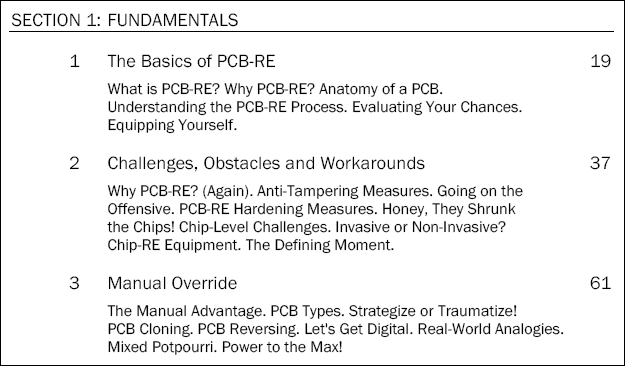
Frequent visitors of my blog will already have a foretaste of the various sample pages of my upcoming book, PCB-RE:Tools & Techniques. The completed book now stands at 368 pages with seven main contributors taking up about 40% of the content, and the remaining 60% contributed by me. For a sneak preview, here's the table of content:


There are a total of three sections and an appendices:

The first section introduces the fundamentals of PCB-RE and also an expanded treatment of the manual approach for digital, analog, mixed-signals and power supplies, less the Microsoft Visio stuff in my first book. The second section focuses on the various tools and techniques used by the PCB-RE industry, and the third section provides interesting and useful resources such as DIY projects, short write-ups on PCB-RE related freewares, as well as more information on PCB-RE equipment and their vendors.

There are five appendices, each serving different purposes with relevant materials and references that should give the PCB-RE topic a run for your time and money, if you expend the effort to go through them.

There are plenty of nice photos and top quality illustrations, interspersed with rich, juicy footnotes and some fun anecdotes (as usual).

Well, hopefully you're all geared up to get a copy when it is released in probably two weeks' time or less.

Wednesday, November 1, 2017

Latest News

The first draft of the book is finally completed, after a grilling six months of writing, drawing, liaising, collating and editing works. For a book of this magnitude in terms of field scopes and authorship, it is inevitable that challenges and setbacks abound every now and then. Thankfully, there are kind and like-minded people among the contributors to nudge me on, and given me the support when I needed it.

Now that I have the content sorted out and the book cover updated and improved, I've registered and gotten the ISBN number for publishing:


It won't hit the store just yet, until I get Michael Dunn to go through the proof copy and pen the Foreword. Moreover, ScanCAD International's fantastic staff will also be meticulously reviewing through and sifting out typos and grammatical errors. I'm grateful for the strong support and belief both Bill Loving (CEO) and Jeff Rupert exhibited towards my work since they came on board and contributed an invaluable chapter, in fact the largest among the contributors.

There's much to be thankful for, as well as anticipation, much like the birth-pangs experience by any woman with child——a mixed feeling of anxiety and joy. It's been a long wait for those who're following my blog, but I can confidently assure you that it will be worth it.

Stay tune and keep watching... and please help spread the word too! Thanks.

Monday, October 30, 2017

The Final Lap...

As those following my blog would have already know that I am writing the final chapter on FPT-RE, reverse engineering (RE) using the flying probe tester (FPT). Like I said, I would love to have an industry expert write the chapter and guide the readers through the steps, using his machine of choice and sharing his valuable experience. As it is, things did not turn out the way I wanted; instead I had to take on this unenviable task, just so that my book will progress to see the light of day, albeit delayed by almost two months because of this unfortunate incident.

Well, I'm happy to say that I'm almost done with the chapter, and into the final lap of the FPT-RE process. As usual, here's a two-page sample:


I should be able to wrap up the chapter in a day or two, and then it's sending a proof copy to the Editor-in-Chief of EDN Magazine for his review and hopefully, pen the Foreword if he thinks the book befits his time to write it.

Tuesday, October 24, 2017

ATX Power Surprise!

Finally gotten the ATX power supply schematic redrawn and corrected all the reference designation errors:

Since it is done with Microsoft Visio, the drawing will look much better in print, better than what you see here with its limited display resolution. Can you identify the main components of the ATX power supply? The answer is also provided in the one-page scaled-down version following this two-page spanning schematic.

Now back to working on the FPT chapter...

Sunday, October 22, 2017

A Good Distraction...

While working on the FPT chapter, I got a nagging feeling that I missed out something in the power supply section of Chapter 3. As it turned out, I forgot to include the topology diagrams for the linear types and went ahead to create and include them. And since I'm at it, I thought I might as well throw in some additional stuff——an ATX power supply as a PCB-RE example.

Here's a two-page sample:


In my search for a schematic diagram that best illustrates the SMPS design aspect for an ATX model, I found one that suits my expectation in terms of layout design——except that there are a number of errors in the component designations. I decided if I want it to look good in the book, I might as well redo and clean up the drawing myself.

Will revert back to writing the FPT chapter when I'm done with this task.


Saturday, October 14, 2017

ScanCAD Edition

As mentioned in my previous post, I've come up with an interim edition for ScanCAD International Inc. while writing the chapters for the full version of the book. This special edition is now in the final works and will be delivered to ScanCAD in 1-2 weeks time. Below is a 2-page sample:


It gives a rough evaluation of the chances of doing PCB-RE using different approaches for a medium complex 4-layer board. Besides the table and charts, there's also further explanations given for the FPT, X-ray and delayering techniques (not shown). As a bonus, I have included a rare interview with the CEO of ScanCAD on his views about PCB-RE too!

Their next stop will be at Productronica 2017 in Munich, Germany on November 14-17. Interested readers in Europe who are going to this exhibition, do keep a look out for ScanCAD's booth...

Sunday, October 8, 2017

One More Chapter to Go...

I'm happy to announce that the JTAG chapter is finally completed! Here is a two-page sample of the 22 pages worth of interesting and informative work I've done.


Will take a short break and then start work with the Flying Probe Test (FPT) chapter. Hopefully, I can get the first draft of the book ready for review by end October...

Friday, September 29, 2017

Good News, Bad News

First the bad news:

My upcoming book, PCB-RE: Tools & Techniques, will be further delayed due to the non-committal attitude of the last contributor on the FPT and JTAG chapters. This is an unfortunate turn of event and I felt bad for the other contributors who have put in their time and effort, though it was not my fault entirely. In the end, I decided it is better that I write the chapters myself than to depend on someone who keeps playing the delaying game with me.

Like I put it in advance at the ending of the book:
I'm not a person who gloss over details on a subject or task I set my mind to learn or undertake, which is why contributors to the various chapters in this book can appreciate my editorial expectations on their works to ensure readers have the best overall reading experience.
And now the good news:

Bill Loving and Jeff Rupert of ScanCAD International, Inc. have been strong supporters for my book and in view of the delay, I have proposed a special ScanCAD edition to the book for their upcoming exhibitions:


They will be giving away free copies of this book and also my first engineering book The Art of PCB Reverse Engineering to existing and potential customers. So keep a lookout for ScanCAD's booth at these events:

SMTA Guadalajara 2017 - Guadalajara, Mexico - October 18-19, 2017 - USM Reps
Productronica 2017 - Munich, Germany - Nov 14-17,2017
DMC/DMSMS 2017 - Tampa FL, USA - Dec 4-7, 2017 - ScanCAD Booth 501
IPC/APEX 2018 - San Diego, CA, USA - February 27- March 01 ,2018 - ScanCAD Booth

That's all for now. Stay tune for more updates...

Sunday, September 3, 2017

Completed. Well, Not Quite...

I'm happy to announced that I have completed the last chapter of Section 1 of my book, comprising three chapters on the Fundamentals of PCB-RE.


Don't be misled by the simple outline and sub-headings of these chapters. They're jam-packed with lots of interesting information and illustrations. Chapter 3 is perhaps the largest chapter of the whole book (40 pages) but overall I am rather pleased with the structures of each individual chapter, having spent much time writing and drawing the illustrations (in Visio), as well as getting the relevant photos for the topics discussed, either directly from the original sources, or requested for permission to use. All these took time and effort to liaise and collate, not to mention processing and proportioning the images so they turn out great for publishing.

My part is done, but I will be going through the completed portions while I await the two chapters for Section 2 from the last contributor, which he promised will be ready by Wednesday. Let's hope he keep to the schedule...

Friday, September 1, 2017

Image to Gerber Conversion

Early this month I mentioned an image to Gerber conversion java program that can be an alternative for those who do not want to learn or use a PCB layout program. I was informed by the programmer a few days ago that there is a new version available at Sourceforge, so I went over and downloaded the package to give it a try.


There were a few improvements made, specifically the ones I suggested, namely the ability to save the selected colors and better contrast for the WhatsThisColor dialog box when the mouse moves over a darker color background. On top of that, the ability to select which of the four color artworks to replace is a nice feature too.

If you have not give it a test drive yet, go to the following link to download the program:

https://sourceforge.net/projects/imagetogerberconverter/

It's free but if you think it's useful to you, a small donation to the programmer is a nice gesture of appreciation for sure!

Wednesday, August 30, 2017

Progress Update (Mixed Signal)

Two sample pages on reversing mixed signal PCBs which I've completed today. This time, I'm showing the portion on PCB design considerations:


The last portion will be on power supplies. I foresee that the book will hit over 320 pages when I'm done with this chapter. There's two more chapters to go, from the last contributor. Hopefully, I'll get the drafts on the Flying Probes and JTAG to incorporate into the book soon...

Friday, August 25, 2017

Progress Update (Analog PCBs)

Just completed the topic on reversing analog PCBs. Here's two sample pages:


Now going on to mixed-signal PCBs and then power supplies. Should wrap up the chapter by end of August. Then it's a final review of the various chapters before sending the draft to the Editor-in-Chief of a well-known magazine for his review.

Monday, August 21, 2017

Progress Update (Digital PCBs)

I've just completed the topic on reversing digital PCBs, and thought I'd put up two sample pages for readers to take a look:


Besides introductory notes on the various digital logic thresholds and operating voltages, emphasis on the importance of preparation work, and the steps involved in doing digital PCB-RE, I also expanded on each of the steps with illustrations and photos, followed by discussion on design considerations for this type of PCBs, peppered with informative footnotes along the way.

The way things are going for this third chapter, it's probably going to take up more pages than I had initially anticipated. Good for the readers, but certainly more work for me!

Friday, August 18, 2017

Progress Update (PCB Reversing)

In The Art of PCB Reverse Engineering I laid out detailed steps and procedures on how to recover the schematics from a physical PCB, from determining the board's accessibility, identifying components and creating a bill of materials (BOM), removing conformal coating if it is present, to gathering parts datasheet and information as a pre-requisite preparation prior to the actual work.

Systematic documentation of the process and strategic approaches for different PCB types are just as important, and I took great pains to show how this is done using Microsoft Visio as the diagramming tool of choice, first to create a layout diagram populated with component symbols that are either simple (basic geometrical entities) or smart (Visio's Smartshapes that are embedded with data and formulas), and on to producing schematics that are consistent and readable using the netlist extracted from the physical board. There are also numerous advanced topics included in that book as well.


This sequel to my first book, though aimed at giving readers a broad sweep of the industrial tools and techniques on PCB-RE,  will nevertheless still be incomplete without some mention on manual PCB-RE. My intention is to familiarize readers with the steps involved without overbearing with details, and at the same time to look at PCB-RE from a design perspective to understand important characteristics of different PCB types and in the process, gain a better chance of success.

A reader put forth this feedback to me:
Perhaps what I would like to see more in the midst of explaining component features and how to draw them in Visio is also the different characteristics and features a PCB can hold. It'll be helpful to explain why traces are drawn in a certain way, which may tell you a lot about the PCB as well as its layer design and characteristics such as grounding, shielding, vias and all the rules it must adhere to etc.
Though PCB design is not my forte, I have experimented with different PCB layout programs and know the importance of design and electrical rules checks, and had worked on quite a variety of PCBs to appreciate their underlying design considerations. Generally, the three main concerns are:

1. Electromagnetic interference (EMI)
2. Signal integrity (SI)
3. Thermal management

These factors, plus some others, ultimately affect how components are placed, the way copper layers and power planes are arranged, how signals are routed, the kind of vias to use, and whether additional heat dissipation measures are required, etc. 

And as requested by the above reader, I will first list the generic steps involved in reversing each type of PCB——digital, analog, mixed-signal, power——and then follow on with some design specifics related to each PCB type. The sequel book content will therefore compliment The Art of PCB Reverse Engineering in this respect.

Friday, August 4, 2017

Progress Update

Currently, I'm writing the final chapter in the Fundamentals (Section 1) of my book. It deals with manual PCB-RE, the advantages of doing it by hand, the types of PCBs, the need for strategies working with different types of boards, and more recently the steps involved with PCB cloning, which I've laid out in six steps. Before moving on to PCB Reversing, I mentioned one interesting Java program which I found online, while searching for raster to Gerber conversion as an alternative option for those who may not want to learn how to use a PCB layout program.

I downloaded the package from Sourceforge, installed the latest Java, setup the environment and path in the system variables, then fired up the program from the command prompt. For a test drive, I loaded a moderately complex board layout, set the color tolerance to 50, and selected the top (red), bottom (blue), silkscreen (yellow) and drill layers (brown):


The results are pretty good, though there are certain improvements that need to be made before it can be a really useful program. For those interested to see it in action, there is a YouTube video online at:

https://www.youtube.com/watch?v=RdQ_jO0g25A

I still have two chapters in waiting for Section 2, coming from an industrial engineer on FPT and JTAG. Hopefully, I don't have to wait too long for the first drafts to start integrating the contents into their respective chapters. I really hope to get the book ready for release by end August, or latest early September.

Thursday, July 13, 2017

My Upcoming Book...

The past couple of weeks I have been busy with my next book, PCB-RE: Tools & Techniques. It is a sequel to my first engineering book, The Art of PCB Reverse Engineering. Those of you who bought it will have learnt that it is a book on doing PCB-RE the manual way using Microsoft Visio as the diagramming tool of choice for properly documenting the process from start to finish.

Well, the focus of this sequel book is different. Much, much different. It is meant to give the PCB-RE practice a more complete treatment by addressing the tools and techniques used by industry experts and practitioners, and covers topics like PCB deconstruction, flying probes, ScanCAD, JTAG, clip-and-learn, Chip-off forensics and X-ray. And it will not be a one-man effort this time because I have enlisted the help of a number of highly experienced people to contribute their knowledge in the area they're good at. It will be a one-of-it's-kind book on PCB-RE. For sure!

In case you're curious, here is the front cover of the book:


For once, I get to be both the author and editor-in-charge, like John Black in his voluminous book, The System Engineer's Handbook. You will get to know the various authors in the Contribution List, the Acknowledgment, and at the end of each chapter they contributed. There are three sections to the book: Fundamentals, Tools & Techniques, Resources and an Appendix that is informative in itself.

That's all I have to say for now. If you've not gotten a copy of The Art of PCB-RE, then perhaps it's time you do, in anticipation of the sequel to it. ;)